



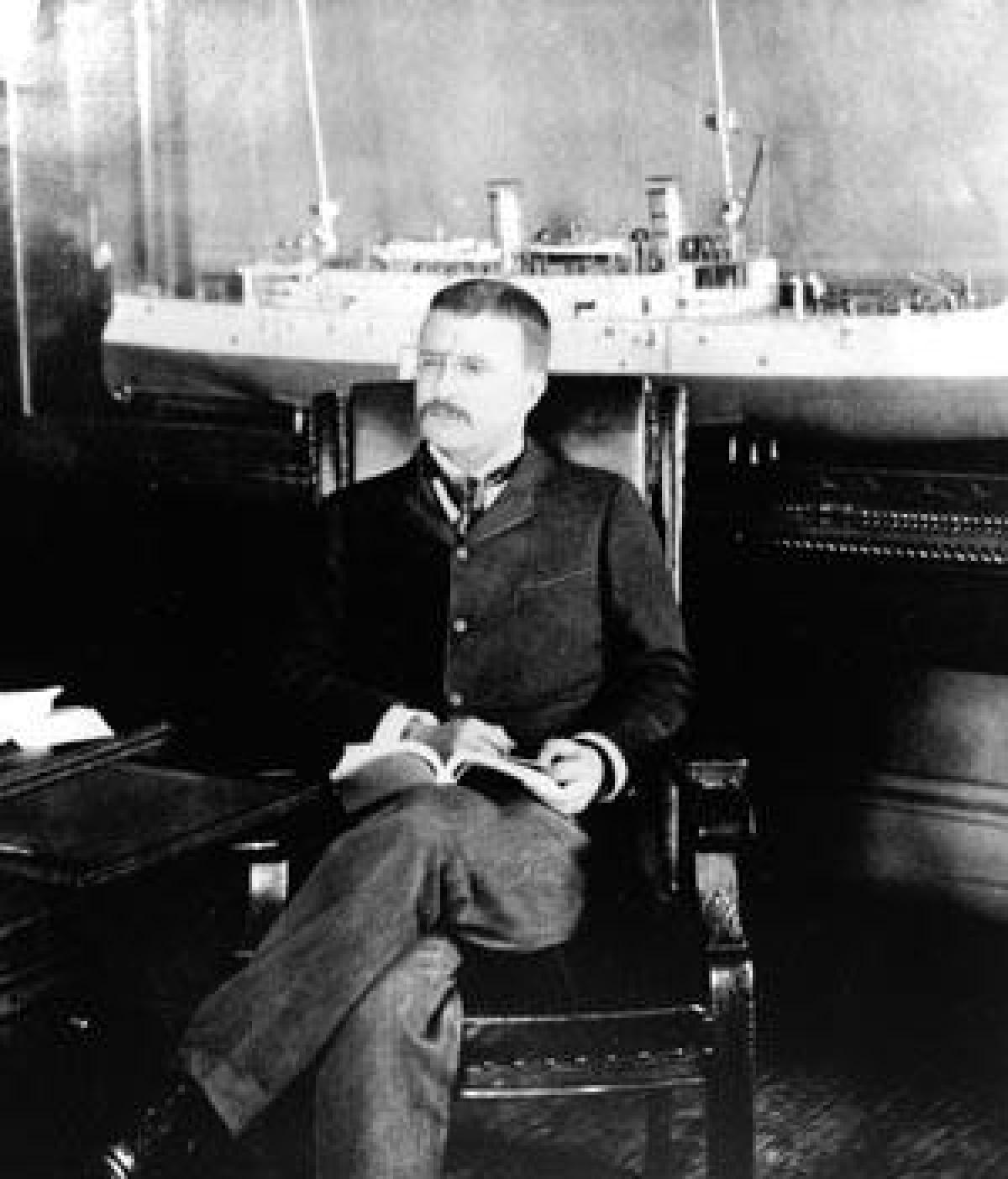
Secretary of the Navy John Davis Long epitomized 19th-century courtliness and reserve. Reasoned, patient consideration characterized his decisions. Affecting an air of frailty, he appeared to be a much older man. Hence, it came as no surprise that on the morning of 25 February 1898, after only a few hours of work, he left the State-War-Navy Building to rest at home.
On returning the following morning, he was shocked to discover his assistant had done nothing less than shift the basic mission of the U.S. Navy from homeland defense to power projection. In a flurry of activity over a brief five hours, the Assistant Secretary of the Navy (Acting-Secretary in Long's absence) ordered warships in the Atlantic and Pacific to forward positions, directed the purchase of additional stores of coal and ammunition, moved state-of-the-art guns from the Washington Navy Yard to battleships based in New York, and placed docked ships on alert for immediate movement.1 By these actions, the U.S. Navy committed its government unilaterally to a Great Power role in world affairs, consigning the reticent doctrines of George Washington, Thomas Jefferson, James Monroe, and John Quincy Adams to the historical refuse heap. Stunned by the magnitude of his subordinate's actions, Long remarked in his diary, "the very devil seemed to possess him yesterday afternoon."2
If Theodore Roosevelt was possessed, it was a life-long affliction. By 1898, he claimed the titles of author, New York State Assemblyman, rancher, New York City Police, and United States Civil Service Commissioner, all with credibility. In each role, his efforts bordered on fanaticism. A contemporary, Henry Adams, grandson and great-grandson of presidents, described Roosevelt as a being of "pure act."3 But T. R. had never moved so boldly or independently. Many of his detractors cite this day as an example of his recklessness, but the historical record suggests otherwise. Roosevelt's actions, though executed rashly, represented a culmination of months of careful thought and preparation.
Assumption of Duties
During the election campaign of 1896, Roosevelt dedicated himself to the success of the Republican ticket. An oddity among New York's social elite, the young man plunged into partisan politics after graduating from Harvard in 1880. Having held numerous minor public offices in the succeeding years, T. R. sought a real position of influence in 1896. William McKinley's successful presidential campaign gave Roosevelt hope. Just days after the new President took the oath of office, T. R. confided to a friend: "The machine people here evidently have it in their heads that I am to be made Assistant Secretary of the Navy."4 The position could not have been more appropriate.
On 19 April 1897, at age 38, Roosevelt assumed his duties as the second-ranking civilian in the Department of the Navy. He remarked:
I have assumed my new duties today, and although I am as yet unfamiliar with the details, I believe that my surroundings here will be most pleasant. As you know, I have always taken a great interest in the Navy, and I sincerely hope that my connection with the service will be as beneficial to it as it will certainly be to me.5
His new boss, Secretary Long of Massachusetts, was a former governor and a poet of minor success. He began his professional relationship with Roosevelt with great misgivings but quickly grew to appreciate the young man's energy. Roosevelt considered the elder man "a perfect dear." Long moved quickly to define his assistant's role. In an internal memorandum, he directed Roosevelt to:
At all times when the Secretary of the Navy shall be absent from the Department, whether such absence shall continue during the whole or any part of an official day, perform the duties of the Secretary of the Navy and sign all orders and other papers appertaining to such duties.6
Roosevelt returned to Oyster Bay, New York, to spend time with his growing family the following weekend. But in a combination of a sense of duty and lost opportunity, he returned to Washington, promising Long that he never would leave Washington again unless ordered specifically. In typical T. R. fashion, he justified his devotion to duty with the words, "I don't wish again to be away when there is the slightest chance that anything may turn up."7
The hot and humid Washington summer provided the Assistant Secretary the opportunity to exert his considerable energies. Long returned to his Massachusetts farm to avoid the unpleasant weather, leaving Roosevelt in charge; he did not hesitate to act. Replying to a formal request from a member of Congress, Roosevelt stated joyfully: "At last . . . I am in sole command, and your request goes through. . . . I am not certain that my conduct will be approved, but I made up my mind. . . ."8
To his credit, Roosevelt dedicated himself completely to work for which Long had neither the interest nor the energy. Comfortable with the broad questions of naval strategy, he immersed himself in a study of the technical, administrative, and logistical challenges facing the U.S. Navy.9 As he chaired or sat on numerous exploratory committees that spanned all naval activities, his confidence grew. During this period he finalized decisions that Long had avoided for various technical and political reasons.10 Roosevelt, never one to avoid controversy, had the time of his life. Writing to friends, he recounted his time as the "hot weather Secretary." He wrote: "The Secretary is away, and I am having immense fun running the Navy. I am absorbed in my work. It is delightful to be dealing with matters of real moment and of great interest. . . ."11
Gestation
Roosevelt entered the Navy Department with a coherent philosophy regarding the Navy and the nation. Following the appearance of his historical book, The Naval War of 1812 (Annapolis, MD: Naval Institute Press, Classics of Naval Literature, 1987), he consistently promoted a big Navy and an enlarged role for the United States in world affairs. In May 1897, Roosevelt corresponded with Captain Alfred Thayer Mahan on the need for naval expansion and a strong fleet-support infrastructure in both the Pacific and Atlantic oceans. Mahan and Roosevelt had communicated for years on similar subjects, but Roosevelt's letters were becoming more specific as he sought Mahan's advice and criticism.
Painting with a broad strategic brush, the novice sub-cabinet functionary boldly stated to the Navy's pre-eminent theorist:
If I had my way we would annex those islands (Hawaiian) tomorrow. If that is impossible I would establish a protectorate over them. I believe we should build the Nicaraguan canal at once, and in the meantime that we should build a dozen new battleships, half of them on the Pacific Coast. . . I would send the Oregon [BB-3], and, if necessary, also the Monterey [BM-6] (either with a deck load of coal or accompanied by a coaling ship) to Hawaii. . . . But there are big problems in the West Indies also. Until we definitely turn Spain out of those islands (and if I had my way that would be done tomorrow), we will always be menaced by trouble there.12
Within days, perhaps at Mahan's request, the head of the Naval War College forwarded T. R. copies of war plans dealing with Pacific and Atlantic contingencies.13 Created under the guiding hand of the director of the new Office of Naval Intelligence, Lieutenant Commander William W. Kimball, these plans represented detailed preparations and execution orders covering a wide range of contingencies. Now, with Kimball's plan in hand, Roosevelt began to flesh out his strategic skeleton.
But the Assistant Secretary had yet to overcome the innate resistance of his boss, who remained skeptical of the need for a larger U.S. fleet, particularly battleships. Uncomfortable with the constantly evolving nature of European ship construction, Secretary Long feared that any ship laid down in U.S. shipyards would be obsolete before she ever touched water. Primarily, he questioned the utility of the battleship within the context of the U.S. naval strategy. If the Navy remained a coastal defense force, perhaps smaller, cheaper battle cruisers would fit the bill. Battleships bespoke an offensive strategy not in keeping with traditional policies. Roosevelt began working behind the scenes, turning again to Mahan for assistance:
My dear Mahan,
In strict confidence I want to tell you that Secretary Long is only luke-warm about building up our Navy, at any rate as regards battleships. Indeed, he is against adding to our battleships. This is, to me, a matter of profound concern. I feel that you ought to write to him—not immediately, but sometime not far in the future—at some length, explaining to him the vital need of more battleships now. . . .14
Ultimately, Roosevelt recognized he needed more than just Mahan's assistance to overcome the reticence of the American people.15
Years before, young Theodore Roosevelt began a relationship with fellow Harvard graduate Henry Cabot Lodge. Lodge taught and lectured at Harvard before going on to serve in the Massachusetts House of Representatives, the U.S. House of Representatives, and the U.S. Senate. Along the way, Lodge wrote on historical and political subjects, even co-writing a book with Roosevelt. Sharing an expansionist worldview and a belief in the essential role of the Navy in elevating the position of the United States in relation to the European powers, Roosevelt and Lodge worked together to turn their ideas into a modern battle fleet.
Much as he had with Mahan, Roosevelt used Lodge as a foil for his ideas. As autumn settled over the nation's capital in 1897, Roosevelt approached Long with his increasingly detailed proposals for a larger Navy. Convinced that the United States faced conflict with either Japan or Spain in the near future, T. R. aggressively sought the enlargement of the fleet. On Wednesday, 29 September 1897, Roosevelt set the stage by asking the Secretary's permission to meet with him to discuss a major change in naval policy.16
Early the following day, Roosevelt presented a detailed memorandum to Long. Drawing heavily from the Kimball war plan, he framed his proposal against the background of the imminent annexation of Hawaii and the ongoing challenge of upholding the Monroe Doctrine in the Western Hemisphere against the increasing pressures of European colonial expansion. Reminding his superior that warships serve the dual purpose of preserving peace as well as winning wars, he characterized battleships as "the cheapest kind of insurance." Roosevelt stated specifically: "I believe that Congress should at once give us six (6) new battleships, two (2) to be built on the Pacific and four (4) on the Atlantic; six (6) large cruisers, of the size of the Brooklyn [ACR-3], etc."
Demonstrating a sophisticated grasp of the complex issues underlying a buildup of naval forces, T. R. drew Long's attention to the need for new dry docks and the expansion of existing facilities. In addition, Roosevelt pressed for the rapid conversion of obsolete guns then on board line vessels with new, rapid-fire weapons rolling out of the Navy's factory at the Washington Navy Yard. Finally, he called for the purchase of a reserve supply of projectiles.17
Roosevelt used two high-powered strategic theorists as foils for his expansionist ideas. For years before he became Assistant Secretary of the Navy, T. R. confided in and sought the advice of one of the greatest naval thinkers of all time—Captain Alfred Thayer Mahan—and Massachusetts statesman, fellow Harvard alumnus, and current Harvard instructor and lecturer Henry Cabot Lodge.
Papers containing Rooseveltian ideas—yet bearing Long's signature—began to emerge from the Navy Department. Confident of the "righteousness" of his cause and its ultimate success, Roosevelt turned his attention to the operational fleet. Then, as now, day-to-day management of the fleet was a jealously guarded prerogative of its uniformed leaders. To prepare the ships currently at sea, Roosevelt needed the assistance of someone with considerable influence, and he needed it quickly. Tensions with Spain were rising rapidly, and the Navy remained woefully unprepared. Capitalizing on arguments honed by months of careful thought and challenging written and verbal dialogue with Mahan and Lodge, Roosevelt brought his powers of persuasion to bear on the Commander-in-Chief, President McKinley.18
Leading with an analysis of every ship class in the fleet, followed by a detailed overview of tactics and strategy, and the character and capabilities of senior commanders, he ultimately requested ships be positioned near Cuba and the Philippines in preparation for the outbreak of hostilities.19 The President remained entirely unconvinced. Frustrated by President McKinley's lack of response, Roosevelt nevertheless promised he "would guarantee that the Department would be in the best possible shape that our means would permit when war began."20 Choosing to regard President McKinley's indifference as passive assent, T. R. proceeded as a man on a mission.
Positioning U.S. Warships
During this era U.S. naval operations centered around loose squadrons. Roosevelt set out to forge coherent battle groups. As early as June 1897, standing in as Secretary in Long's absence, he wrote an addendum to an order authorizing an August exercise:
I am especially anxious to see you try our seven seagoing armor-clads in squadron, for although they include three 1st-class battleships, two 2nd-class battleships and two armored cruisers, yet they are sufficiently alike in type to make it possible to manoeuvre with them, and I suppose they will all be used in the line if we have a naval war.
In his typical fashion he invited himself along to view gunnery drills.21
Roosevelt then turned his attention to the question of where these forces might be most effective. Months prior to the sinking of the battleship Maine, T. R. confided to Mahan that he was promoting a strategy to position the preponderance of the Atlantic Fleet off Key West, with the remainder directed to the coast of Spain to harass commercial shipping and selected Spanish ports. In the Pacific, "our Asiatic squadron should blockade, and if possible take, Manila."22 T. R. warned that all actions must be swift, lest they invite the attention of powerful European imperialist poachers.
As late as 14 January 1898, Roosevelt lobbied Secretary Long urgently to prepare the ships at sea for war. Warning that inadequate preparation courted disaster, he requested a "radical" alteration of the disposition of the fleet. Referring to the Kimball war plan, he again suggested the Atlantic Fleet be moved to Key West and the newly installed Asiatic squadron commander, Commodore George Dewey, be directed to prepare for actions in the Philippines.23 Long considered his assistant's suggestions, and did nothing.
Requisition of Coal
Turn-of-the-century naval vessels depended on coal for propulsion. To support a blue-water policy, nations required overseas bases to service their ships, or at least a significant number of support vessels to provide replenishment. For years, Roosevelt, Lodge, and Mahan had advocated the acquisition of both. While the movement to annex Hawaii promised to provide a central hub for U.S. Pacific operations, years would pass before the necessary infrastructure could be erected, years that the Assistant Secretary of the Navy felt his nation did not have.
Roosevelt envisioned a Navy operating independently in three regions. To enable U.S. fleets to operate for extended periods, T. R. lobbied to procure strategic reserves of coal, transport ships (colliers to accompany and resupply the warships), and enhance the capabilities of forward-positioned maintenance facilities.24 As war with Spain drew closer, the warnings became more strident. In a January letter to Long, Roosevelt stated boldly: "They [the Atlantic Fleet] should be at Key West and filled with coal in readiness for action . . . ." He concluded his letter with the advice: "Well in advance we should get every vessel . . . especially an ample supply of colliers."25
Requisition of Guns and Ammunition
Roosevelt's efforts to lay up ample supplies of coal were dwarfed by his actions to obtain new guns and accompanying ammunition. In a June 1897 letter to a Navy engineer, Roosevelt wrote:
We need to replace our old slow-fire guns on the battleships and cruisers with modern rapid-fire guns. A battery of rapid-fire guns has been provided by law for the [screw sloop] Hartford, where they are of no earthly use; at least as compared with the use they would be if put upon the Philadelphia [C-4] or San Francisco [C-5]. I am very anxious to consult with you to find out if there is not some way by which we can put this battery on one of these two ships where it will be of real service.26
His letters began referring to the need to match the most capable ships with the most capable weapons.27 In some cases he expressed regret over previous decisions that had proved ineffective. Referring to a decision to substitute a more rapid-firing 6-inch gun for an older 8-inch gun throughout an entire class of battleships he wrote, "I personally rather regret that the 8-inch gun was taken off these battleships. It is to a certain extent an armor piercer, and the 6-inch gun is not."28 As new guns emerged from the Navy's gun factory, Roosevelt urged they be installed "as rapidly as possible." War approached.
T. R. realized quickly that new guns required new ammunition and doubted that current stockpiles would last through the duration of the conflict. Forecasting expenditures, he wrote, "We should provide a reasonable reserve supply of projectiles (about nine thousand in all) so as to permit a complete refill of all the ships."29 In letters to Long, he characterized the requirement for more ammunition as an "urgent need."30
Fleet Readiness for Action
Roosevelt's correspondence referred consistently to the need for all available ships to maintain a high state of readiness. Then, his attention shifted from the ships at sea to those in dock facilities under repair.31 Eager to bring a preponderance of force to bear against the enemy, Roosevelt exempted no ship from his attention.32 From battleships to post-Civil War monitors, T. R.'s plans allowed room for all to participate. Speed was of the essence. Reinforcing Henry Adams's characterization, Roosevelt required constant action. A representative letter from this period is sprinkled with the words "immediate and prompt," and "as quickly as possible" along with time limitations such as "within forty-eight hours."33 Everything proceeded with a sense of urgency.
Roosevelt was, in his mind, the lone sighted man in a room of the blind. So, after Secretary Long's departure the morning of 25 February 1898, Assistant Secretary (at that moment Acting Secretary) Roosevelt closed his own door and began to dictate messages to the fleet:
Cablegram. Dewey, Hong Kong: Order the squadron, except for the [side-wheel gunboat] Monocacy, to Hong Kong. Keep full of coal. In the event of declaration of war Spain, your duty will be to see that the Spanish squadron does not leave the Asiatic coast and then offensive operations in Philippine Islands. Keep Olympia [C-6] until further orders.34
That Theodore Roosevelt acted without the authorization of his superiors cannot be argued. Neither the President nor the Secretary of the Navy would have approved of Roosevelt's plans that day. They certainly knew of them and the logic behind them, but out of philosophy, political economy, or ignorance, they disregarded them. Despite strong negative reaction to T. R.'s activities, not one of his messages, requests, or orders was rescinded.
Roosevelt had found his fulcrum, and the philosophy of the Navy tilted from coastal defense to sea control and power projection. The nation began to look outward. Within months it came into possession of Cuba and the Philippines, arriving on the world stage as a bona fide "great power." For the next century the United States continued to grow in influence, with the Navy fulfilling a critical role in the development of U.S. foreign policy. Crises today often spark the question, Where is the Navy? It is where Roosevelt placed it a century ago, patrolling the oceans, projecting and protecting the influence and prestige of a "super power."
Roosevelt's actions on 25 February 1898 left his friends Mahan and Lodge satisfied. Roosevelt, for his part, was not. Having expended his influence in the Navy Department in one desperate act, he realized even before Long returned to the office he had no future there. His final letter on 25 February went to General C. Whitney Tillinghast, commanding general of the National Guard in his home state of New York, warning him he should begin preparing his units for action in the coming conflict. In exchange for this valuable information, he made one simple request, "Pray remember that in some shape I want to go."35
1. The original Letterbooks from which these orders were extracted are located in Records Group 80, Records of the Department of the Navy, National Archives, Washington, DC. back to article
2. John D. Long, Journal, 26 Feb. 1898, Margaret Long, ed. (Boston, MA: Massachusetts Historical Society, 1946). back to article
3. Henry Adams, The Education of Henry Adams (New York: Random House, 1931), p. 417. back to article
4. Roosevelt to Henry Cabot Lodge, 23 Mar. 1897. The Letters of Theodore Roosevelt, Volume I, Elting E. Morison, ed. (Cambridge, MA: Harvard University Press, 1951), p. 590. Cited hereafter as Letters. back to article
5. Letters, Roosevelt to Captain Bowman McCalla, 19 Apr. 1897, p. 599. back to article
6. Long, Journal, 21 Apr. 1897. back to article
7. Letters, Roosevelt to John D. Long, 26 Apr. 1897, pp. 603-604. back to article
8. Letters, Roosevelt to Senator Cushman Davis, 13 Aug. 1897, p. 649. back to article
9. Letters, Roosevelt to Long, 18 Jun. 1897, p. 628. back to article
10. Roosevelt to Lodge, 17 Aug. 1897, Selections from the Correspondence of Theodore Roosevelt and Henry Cabot Lodge 1884-1918 Volume I, Henry C. Lodge, ed. (New York: Charles Scribner's Sons, 1925) p. 272. Cited hereafter as Selections. back to article
11. Letters, Roosevelt to Bellamy Storer, 19 Aug. 1897, p. 655. back to article
12. Letters, Roosevelt to Captain Alfred T. Mahan, 3 May 1897, p. 607. back to article
13. Letters, Roosevelt to Captain Henry Taylor, 24 May 1897, p. 617. The war plans author, Lieutenant Commander William W. Kimball, went on to lead the Torpedo Flotilla Squadron during the Spanish American War, testing many of his own plans for fleet maneuvers on a smaller scale. back to article
14. Letters, Roosevelt to Mahan, 9 Jun. 1897, pp. 622-23. back to article
15. Letters, Roosevelt to McCalla, 3 Aug. 1897, p. 636. back to article
16. Selections, Roosevelt to Lodge, 29 Sep. 1897, p. 284. back to article
17. Letters, Roosevelt to Long, 30 Sep. 1897, pp. 695-696. back to article
18. Letters, Roosevelt to William McKinley, 26 Apr. 1897, pp. 602-603. back to article
19. Selections, Roosevelt to Lodge, 21 Sep. 1897, p. 278. back to article
20. Letters, Roosevelt to Lodge, 15 Sep. 1897, pp. 676-677. back to article
21. Letters, Roosevelt to Admiral Montgomery Sicard, Commander, North Atlantic Station, 17 Jun. 1897, pp. 626-627. back to article
22. Selections, Roosevelt to Lodge, 21 Sep. 1897, p. 278. back to article
23. Letters, Roosevelt to Long, 14 Jan. 1898, pp. 759-762. back to article
24. Selections, Roosevelt to Lodge, 21 Sep. 1897, p. 278. back to article
25. Letters, Roosevelt to Long, 14 Jan. 1898, pp. 759-762. back to article
26. Letters, Roosevelt to Charles A. Boutelle, 22 Jun. 1897, p. 629. back to article
27. Letters, Roosevelt to Long, 18 Feb. 1898, pp. 778-779. back to article
28. Letters, Roosevelt to William Clowes, 3 Aug. 1897, p. 637. back to article
29. Letters, Roosevelt to Long, 30 Sep. 1897, pp. 695-696. back to article
30. Letters, Roosevelt to William Clowes, 3 Aug. 1897, p. 637. back to article
31. Letters, Roosevelt to Long, 9 Aug. 1897, p. 642. back to article
32. Letters, Roosevelt to Long, 13 Aug. 1897, p. 650. back to article
33. Selections, Roosevelt to Lodge, 21 Sep. 1897, p. 278. back to article
34. Letters, Roosevelt to Commodore George Dewey, 25 Feb. 1898, pp. 784-785. back to article
35. Letters, Roosevelt to General Whitney Tillinghast, 25 Feb. 1898, p. 784. back to article