


VIEW PROCEEDINGS ARCHIVES


The Wrong Ship at the Wrong Time
SocialTwist Tell-a-Friend

USNI Image Gallery

U.S. Navy

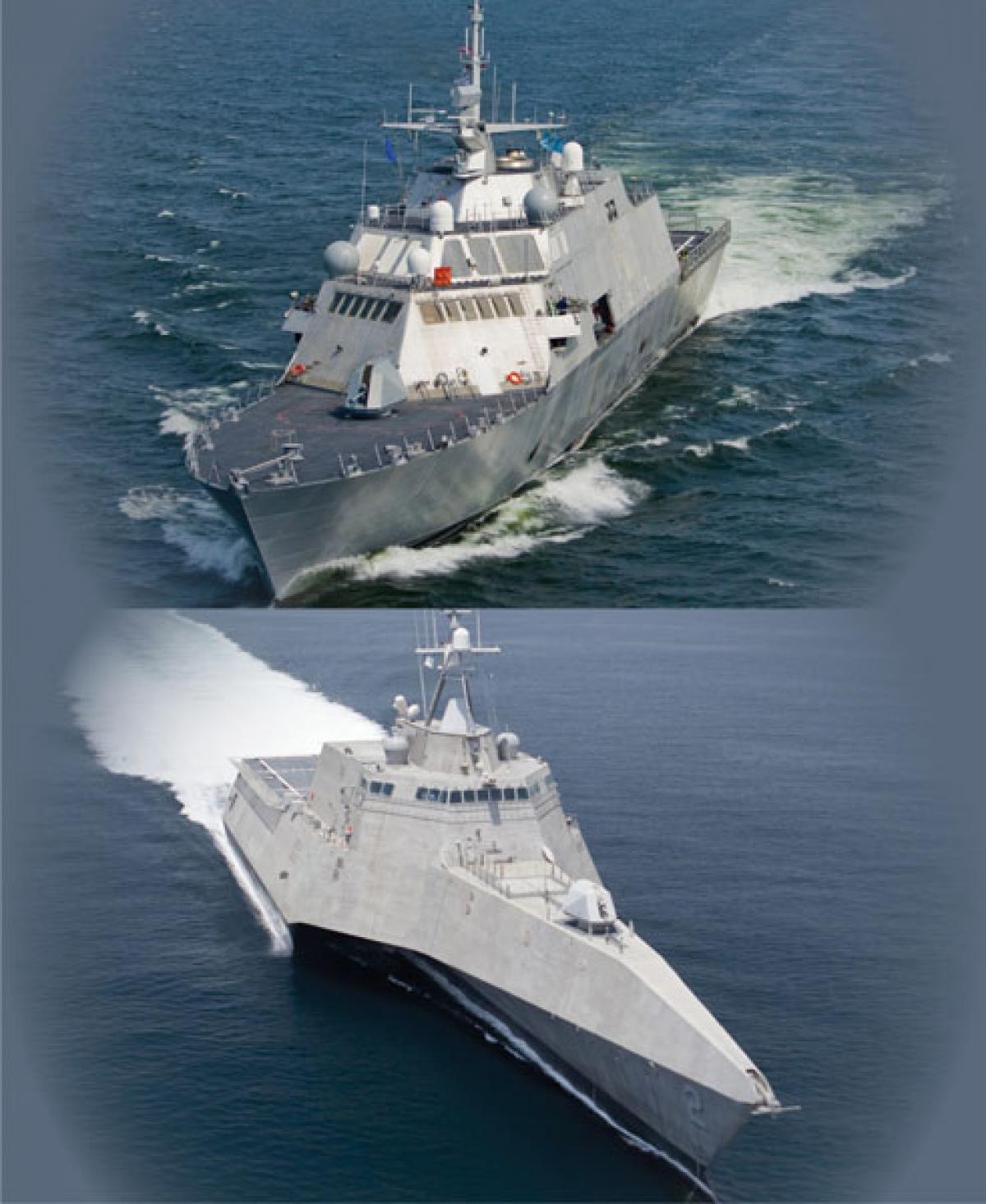
The littoral combat ships (top) USS Freedom (LCS-1) and (bottom) Independence (LCS-2) are in the vanguard of a nascent ship class, but both variants already are weighed down by increasingly expanding requirements, and "despite the fact that LCS is a poster child for platform-mission creep, the Navy is still adding more systems," the author notes.

BAE Systems Ship Repair (Ed Ketz)

The Independence arrives at BAE Systems Ship Repair in Norfolk, Virginia, for additional component-installation in May 2010. According to the author, "The basic problem with the LCS program is that from inception, it suffered the ills of Navy attempts to design, build, deploy, and sustain a small warship to do too many things."

USNI Image Gallery
Small Text
Regular Text
Large Text
 
It is clear that the Littoral Combat Ship (LCS) program cannot live up to expectations. Yet the surface Navy still badly needs low-end ships for littoral and maritime-security missions.
 

Since the concept phase of the LCS program, supporters and detractors alike have argued for or against the ship class. Recently, however, the debate has shifted away from pundits to official U.S. government assessors, with arguably damning conclusions about the ships. Navy leaders espousing the virtues of LCS-1 and -2 are increasingly in the minority amid a rapidly building case for the program’s dramatic restructuring—or demise. Instead of muddling forward to an almost certainly marginal outcome, the Navy should cancel the LCS program and acquire a proven single-mission hull.

Scrutiny on the LCS is nothing new. Still, summing up previous criticisms of the LCS is worthwhile—though the list of deficiencies and concerns is long:1

• Unaffordable. The near tripling of the expected hull price tag and unrealistic Navy cost estimates are well documented in current literature, but they become a stark program stigma amid current Department of Defense fiscal austerity. Life-cycle costs of the two “orphaned” LCS hulls after the down-select decision are also a factor.

• Too complex. All the higher-end, multi-mission capabilities not only increase costs, but also could make the crews’ tasks unmanageable.

• Excessive technical risk. Incomplete designs at production start exacerbated risk. Some LCS components are also technically unproven or exhibited problems during acceptance trials, such as water-jet tunnel pitting and corrosion and the need for additional buoyancy tanks.

• Impractical. Expectations of seamless integration of the many mission modules, unmanned vehicles, core hull systems (57-mm gun, radars, etc.) and net-centric capabilities were exceedingly unrealistic.

• Inefficient. The failure of the Coast Guard and Navy to conduct a combined effort to design a new cutter/corvette-sized vessel remains perplexing.

• Vulnerable. Many experts argue that the vaunted speed factor will not protect LCS from littoral antiship-missile or torpedo threats.

• Poor endurance. Both LCS versions rapidly deplete fuel stores—especially at the higher speeds envisioned for anti-access missions and with heavy MH-60R/S helicopter operations—requiring frequent bunkering in port or replenishment at sea.2

• Unstable. Excessive high-end requirements have driven up hull machinery and combat system weight, negatively affecting displacement and stability.

• Logistics-heavy. Staging of the mission modules and associated personnel requires a forward sea base or shore facilities.

• Imprudent. Insufficient analysis before program design and acquisition resulted in spiraling costs to address unanticipated problems.

• Insufficient hotel services. Berthing and support requirements for expanding aircraft, unmanned vehicles, and module detachments have exceeded ship capacity.

New Concerns, Changing Requirements

Several recent, authoritative assessments raise serious new concerns about the LCS. A 2009 assessment by the DOD’s Office of Operational Testing and Evaluation (DOT&E) criticized the premature LCS deployment, which delayed for years the office’s initial hull testing and evaluation, including survivability assessments.3 The wisdom of deploying a new vessel before a full evaluation seems questionable and suggests Navy eagerness to prove the new class amid growing criticism. The DOT&E assessment also expressed concerns about LCS-1’s stability: “The ship will exceed limiting draft in the full load condition,” reducing reserve buoyancy and “the ship’s capability to withstand damage and heavy weather.”4 The report also questioned the limited system-shock hardening, raising issues about whether the warship could actually fight it out in the littorals. The most disturbing statement in the report asserted, “LCS is not expected to be survivable in a hostile combat environment. . . .”5 Indeed, the LCS is no “streetfighter.”

An August 2010 Government Accountability Office (GAO) assessment drew similar critical conclusions.6 The report questioned Navy decisions to continue to implement design changes even as the third and fourth hulls were being built, increasing unit and design costs significantly. Further, the promised warfare-module (also called mission-package) capabilities are in doubt. The GAO statement on the modules that resonates most focuses on the antisubmarine warfare (ASW) module: “Navy analysis of antisubmarine warfare systems has shown the planned [LCS] systems do not contribute significantly to the antisubmarine warfare mission.”7 The report also stressed development and procurement delays for all three mission packages—ASW, surface warfare (SUW), and mine warfare (MIW)—and asserts that those delays prevented their timely fielding, leaving them unproven and leaving the Navy at risk of “investing in a fleet of ships that does not deliver its promised capability.”8

The MIW package, for instance, has components that are not expected to be fielded before 2011, with some as late as 2017.9 Similarly, the Navy has not yet integrated the SUW package’s 30-mm guns into the ship’s combat-systems suite, and DOD canceled the non-line-of-sight missile-launch system in 2010, seriously limiting LCS SUW capabilities. In fact, as of August 2010, the Navy had taken delivery of only five partial mission packages. The report asserts that all of this boils down to two hulls (one already deploying operationally) with functionality largely constrained to self-defense, as opposed to mission-related tasks.

The GAO report also criticized the Navy for accepting delivery of LCS-1 and LCS-2 with both hulls in an incomplete state and with outstanding technical issues.10 Addressing those issues has required the Navy to schedule extensive post-delivery work periods for each ship, adding to program costs and again delaying operational testing and evaluation. Despite the additional yard periods, launch-and-recovery system payload-handling cranes were deemed to have significant safety issues.

As of 2010, Navy leaders still seem to be adding requirements and missions to this already “top-heavy” ship class. The January 2010 LCS Request for Proposals called for adding an SPQ-9B fire-control radar—typically found on larger combatants—that would add complex equipment and increase topside weight and the LCS radar cross-section. The Navy is also purchasing and testing a new variable-depth sonar system for the LCS after it found problems with the existing ASW package.11 Even Marine Corps leaders are seeking to add to LCS missions and system requirements by modifying the ship to carry a reinforced company of Marines.12 Recent LCS-deployed operations also revealed the need for an additional 20 crew to cover missions that the existing 75 cannot, such as boarding operations, despite the fact that maritime interception operations were part of the original LCS mission.13 Add to that the training, equipping, and normal ship services for 20 extra crew, and a vicious cycle becomes apparent: ever-expanding crew requirements. Notwithstanding the fact that LCS is a poster child for platform-mission creep, the Navy is still adding more systems.

In November 2010, Navy leaders surprised many by indicating that they would ask Congress for approval to award contracts to both defense-industry teams for ten ships of each type. The Navy argument is that buying both hull types will “stabilize” the LCS program and support an increased ship-procurement rate.14 But the two ships have very different hull/mechanical and combat-systems suites, which would potentially double the maintenance and training requirements for two virtual ship “sub-classes.” This decision would seem to exacerbate many of the legacy issues described here, especially cost and efficiency concerns.

A Mixed Track Record

Navy accounts of recent LCS operations paint them as successes, but a closer look reveals more uneven results. While the LCS’ high speed did indeed support the interdiction of “go-fast” small craft during 2010 Caribbean counternarcotics operations, that mission itself is on the low end of promised LCS capability—involving none of the high-profile systems for which the LCS is touted. The agility and speed that a helicopter (from any ship) offers in the maritime counterdrug arena, for instance, arguably obviates the 40-knot LCS capability. The capabilities that drew the most praise from the operation were the 11-meter rigid-hull inflatable boat and the Coast Guard Law Enforcement Detachment—not especially exotic in nature and easily deployable on other U.S. warships. Finally, the loss of two ships’ service diesel generators during the operation, which required an in-port repair effort with a manufacturer’s service team flown in from the United States, is troubling. The loss of 50 percent of electrical-generation capability is serious, but the inability of the crew to effect emergent underway repairs raises bigger questions.

The basic problem with the LCS program is that from inception, it suffered the ills of Navy attempts to design, build, deploy, and sustain a small warship to do too many things. It comes down to a decision whether to field small combatants with expensive multi-mission flexibility or single-mission capability to handle the more likely lower-end operational missions in peacetime and war. Small-combatant success stories do exist (Meko, Visby, FFG-7), but a paramount factor in their development was strict limitation of mission scope and capabilities. The alternative is just too expensive and fraught with difficulties—both of which the Navy is dealing with today. Taken alongside the official findings noted previously, the question becomes: How bad does the prognosis for this ship class need to get before Navy or DOD leaders cancel it?

Keep It Simple

Fleet and regional combatant commanders clearly and consistently have a high demand for small combatants, especially frigate-sized warships.15 To meet this growing demand, several options still exist for Navy and DOD leaders to consider:

• Dramatically scale down LCS hull requirements (including 40+ knot speed and mission modules) to what amounts to a basic SUW model with self-defense and helicopter-support capabilities. Since many of the next-generation MIW, ASW, and SUW capabilities of the LCS reside on the MH-60R/S, carrying through with the helicopter-based upgrades and new systems seems prudent regardless of LCS hull or class decisions.

• Cancel the program and shift funds to a corvette based on the Coast Guard’s National Security Cutter hull with basic SUW, self-defense, and helicopter-support capabilities.

• Restart Oliver Hazard Perry–class guided-missile frigate production as an acceptable compromise to cover littoral and low-end missions. The Royal Australian FFG-7 class upgrade is evidence that this basic hull type is still viable.

In all three options, SUW would be the primary-hull mission area, since it is the mission most likely in demand in peacetime and war. The armed helicopters could augment a 57-mm gun and a short-range antiship missile system. A limited-hull ASW capability, however, would be needed for independent littoral operations. Alternatively, an ASW version of any of these hulls is an option in addition to SUW hulls. The thrust here is to keep one primary mission area for optimizing combat systems and crew expertise.

Since Navy leaders first conceived of a small littoral combatant more than a decade ago, the Navy has repeatedly violated its own “keep it simple” golden rule. But it is not too late to alter the LCS program or cancel it altogether in favor of a small, simple, affordable, single-mission warship to provide an 80-percent solution for Fleet and combatant commanders. For now, however, the Navy plans to spend more than $25 billion to acquire 55 hulls and 64 mission packages.16 If the program follows current trends, by 2035 the Navy will have a large fleet of impressive-looking, fast, and fragile ships that cannot handle littoral threats and bring little real combat power to the fight.


1. For a more in-depth discussion of past concerns, see John Patch, “Jack-of-all-trades: the LCS serves too many masters with too many roles,” Armed Forces Journal (September 2007), http://www.afji.com/2007/09/2928967.

2. LCS-1 used more fuel annually than the larger Oliver Hazard Perry–class frigates, according to the Congressional Budget Office. See the 28 April 2010 letter from the CBO to the Honorable Jeff Sessions, pp. 3–5, at http://www.cbo.gov/ftpdocs/114xx/doc11431/04-28-SessionsLetter.pdf.

3. Director, Operational Test and Evaluation, “FY 2009 Annual Report” (December 2009), p. 146.

4. Ibid., p. 147.

5. Ibid.

6. Government Accountability Office (GAO), “Defense Acquisitions: Navy’s Ability to Overcome Challenges Facing the Littoral Combat Ship Will Determine Eventual Capabilities” (August 2010).

7. Ibid, p. 12.

8. Ibid., p. 24.

9. Ibid., p. 17.

10. Ibid., p. 10.

11. “Navy Pushes Back against GAO Criticism of Littoral Combat Ship,” Inside Defense, 3 September 2010, http://insidedefense.com/201009032337368/Inside-Defense-Daily-News/Defen....

12. “Amphibious Operations in the 21st Century, USMC, Marine Corps Combat Development Command (18 March 2009), p. 27, http://www.quantico.usmc.mil/MCBQ%20PAO%20Press%20Releases/090430%20CDI% .

13. Philip Ewing, “20 to join LCS crew on trial deployment” Navy Times, 16 November 2009.

14. Christopher Cavas, “U.S. Navy Asks Congress to Buy Both LCS Designs,” Defense News, 3 Nov 2010, http://www.defensenews.com/story.php?i=4997988. The Navy is holding open the option to down-select a single hull, but must decide by 14 December (before press time) to avoid another round of contract offers.

15. Philip Ewing, “After the frigates are gone,” Military Times, 4 August 2010, http://militarytimes.com/blogs/scoopdeck/2010/08/04/after-the-frigates-a....

16. GAO, “Defense Acquisitions.”


Commander Patch is a retired surface warfare officer, joint specialty officer, and career intelligence analyst. He is currently an associate professor of strategic intelligence at the U.S. Army War College and adjunct faculty at the American Military University. He also serves on the U.S. Naval Institute editorial board.

Cancel the LCS

Simply put cancel it. It has been a posterchild of what not to do with regards to procurement, ship building and design. No consideration was given to the operating area it was designed for and how that would change in hostilities. It will be detected over and over again by any fishing vessel operating in the littorals with it. That information would be passed via cell phone and possible engagement by a shore based ASCM. Looking at the most recent case of ASCM Vs. Small Boy the winner of that was the ASCM. The Israeli SAAR4.5 that was hit (actually it exploded in close proximity to the FFL) resulted in the FFL needing to be towed home. They were fortunate.
A soution can be found in refurbing and converting existing FFG's to more economical operating systems and use Gas Turbines for Boost only. This followed by investment with our foreign partners on a more successful design is the way ahead.
Cancel this experiment now!

Capability requirements

To mitigate the threat of FAC/FIAC swarms, you need to maintain the range of engagements or have massive amounts of close in firepower/armor. Speed is cheaper than a battleship. Speed also allows tactical flexibility to cover more waterspace, reducing the number of ships required for sea control.

Naval combat in the future belongs to drones (air, surface, and subsurface). If a combatant cannot carry and service these vehicles, it will be outclassed by those that do. While an amphibious assault type ship would meet this need nicely, it lacks the speed capability as above, and they are NOT cheap either.

Survivability is directly related to tonnage. No small surface combatant will be mission capable after a direct hit by most modern missiles. No combatant period can take a torpedo hit. Again, not all ships can be battleships, or we would have build more of the 14500 ton DDG 1000.

Capabilities,

I agree that a certain level os speed is desirable, however 20k, 30k, or 40k make little differenc to a missile. Hence me proposal for an A. Burke escort destroyer. The main cost of these ships is the AEGIS system. Leave it out. Replace it with a platform that can defend itself with RAM & ESSM. Harpoon and a lighter SSM for dealing with swarms of PBs. Basicly a US version od the Danish expeditionary ship. But with a more sidnifigant armament. IE, 42 RAM, 64 ESSM, 16 Harpoon and at least 32 smaller SSM for dealing with fast PBs. Such a ship would of course be supported by AEGIS equipped ships. Without AEGIS i beleive that the cost woul be no more than 2/3s a Burke 2A.

Littoral Combat Ship

Now that the ship is here it would be really sad to give up, even if the list of conclusions is not the best.

Take one point after the other and improve slowly the characteristics of the vessel. Also never loose control of the costs.

If you were beginners in the field one could understand about getting sceptic, but it is not the case.

The Wrong Ship at the Wrong Time

Okay you say the Littoral Combat Ship is bad but what do they have to replace it ?

LCS vs FFG

It seems to me that an uprated FFG, ie. twin screws, VLSSM, 2 helos, would be more cost effective. The Danish expeditionary ships seem to be the model.
And since when do you need 40Knts. Few current vessels still beat 30.

LCS vs FFG

How could the LCS best become cost effective?

Better yet, take the existing

Better yet, take the existing perry class design, and clean up the superstructure, or replace the superstructure with a more stealthy design, and replace the single screw with a modern pump-jet, either single or a pair.

a more modern design at a fraction of the development costs.

At that point, we may as well

At that point, we may as well take the design from the South African Valour class. It would cost even less to build an existing design than re-vamp the Perry design. You'd need to play an insane game of musical chairs in the engineering spaces to get a pump jet through the hull and you'd be hard pressed to make that box of a ship stealthy. Any addition to the superstructure would just increase weight and navigational draft, making it worse for in-shore operations. The European corvettes offer a much more promising view of the future than the the Perry class, I think.

At that point,

Of course, the Pentagon will never endorse a foreign design. Look what we did with the Lerci class MH. Biger and twice the price. By the time our naval construction people are done, a MEKO 160 or 200 will be the size of the Spruance class. How about a rad idea. Build a non AEGIS Burke. The hull and engines are a small part of the cost and it's a proven design. Also a shallow water ASW ability. Two helos+drones, one 5"/62, two 57mm several 25mm. For air defense ESSM and RAM. Some Harpoon and a smaller anti PB SSM. Two+ zodiacs for interdiction. You would have 42 RAM & 64 ESSM, more than enough for self defence. As there would be an AEGIS ship over the horizon to deal with major AA & ASW threats. You cannot maintain a fleet of only highest end vessels.
Thus an inexpensive (by US standards) capable ship. The concept is in effect the Danish Expeditionary Ship.

What you have described for

What you have described for the most part, is the already designed and developed perry class frigate.

Just take the Perry's the USN still owns, and either reinstall the missile launcher, or cut out that section up in order to fit a VLS and you are ready to go. Australia has already fitted theirs with a small 8 cell vertical launch system to supplement the missile launcher they didn't remove.

And since the Perry's are already designed, there is little to no development costs associated with building more.

Better yet, take the existing

That songs very realistic! A slightly modified Perry Class design would increase the interest in building it.

LCS

If needed, the polticians should force a common hull and engines on the navy
and coast gaurd. To save time and money the MEKO's would seem to fill the bill. And whats with 40K speed. With helicopters and zodiacs is it usefull for cost. A question is the 57mm worth adding a new system. I saw video of the RCN firing on an old DDG. The 57 didn't seem to do much. The 3"/76 shot it to peices.

Great plan

Great ship , they a lot of new technologies while building .

I agree that the LCS ships

I agree that the LCS ships are probably a failure. even just looking at them on paper they seem way too complicated for what should be a very simple mission.

as i understand it, the ships are supposed to be just really small warships that can go fast into harms way in confined waterways.

i think they should have forgone the multitude of systems in favor of just the core functions with 1 or two 'add-on' packs in the multi-mission section. and in situations where you need more then that, you run more than one ship and spread the load across them.

but perry class frigates i think, pound for pound, are probably far better at what the LCS ended up becoming, and have the benefit of being 'proper' warships, with all the benefits that having a full crew provides.

personally, having looked over even the simplest specifications on them, that the sailors in the navy would be delighted to have a slightly 'upgunned' version of the coast guard's national security cutter for use as a true frigate, maybe even with while retaining the hybrid diesel/gas turbine power plant arrangement that would maintain the resulting ship's very capable range.

even with the somewhat dubious claims i have seen that the ship would be less well built than a ship designed for the navy rather than for the coast guard's rather extreme needs, it would probably be an excellent replacement for the perry class.

Russian LCS

The Bora class guided missile hovercraft looks to me like what an LCS is meant to be next to Visby and the like, but Bora has the speed. Perhaps the discussion can progress if current "LCS" of other nations get evaluated since the general concept seems not to be rather US specific.

Great John Paul Jones' ghost!

Great John Paul Jones' ghost! You don't have to be Horatio Nelson to see this trainwreck for what it is. Unaffordable. Unsustainable. Unarmed. We needed a modern day PT boat but got instead gold plated flaming datums. Get real. Buy some Visby Corvettes, and then fire or retire everyone involved with this waste of time and treasure. Starting with the Admiral Mullins and work yourself down about 5 levels...maybe more.

Well said, And ill add that

Well said, And ill add that thing seems like a flaming death trap for the crew unfortunate enough to have to man it.

I dont see why the USN cant just buy or license a good foreign design or even better, just take an old hull and rebuild them.

Great story and also some

Great story and also some great photos,nice job ;)

Looks great

This ship looks like stuff from future. Really impressive. Wonder how much does this program REALLY cost to US government.

agree..

Agree, this ship really looks awesome...... it looks like a ship from a science fiction movie and I bet it costs us some serious money.

LCS, it Lives up to it's name: Least Capable Ship

Well said... in addition, the manning model for these ships seems ridiculous in our time of down-sizing and reducing the most expensive weapons in our inventory: people!

On that matter, the LCS would demand an extremely well trained, hybrid Sailor capable of fulfilling multiple roles on the smaller crewed ships... why put our most capable/well trained folks on our smallest & least capable platforms?

Finally, the Navy's Optimal Manning Experiment was a failure, why build an entire class of ships based upon a PROVEN failed construct? Look at the way the Air Detachment will be manned - capable of MAX 18 hr days of operations, that's flying plus maintenance!

Maybe its name is right but needs 1 more letter: LCSS Let's Continue Subsidizing Shipbuilding!

What if the politics of the situation won't let LCS be canceled?

If that turns out to be the case, the least worst option may be to scrap the modularity requirement and use LCS as a common hull design for a series of single-mission, experimental warships. Build a pair. If one or both of them succeed, great; the successes get copied in future ships. The failures are modified for new missions as practical. Where missions come up where neither the Freedom nor the Independence design works, you have another piece of ammunition in budget battles.

Wrong Ship, Wrong Time

Commander Patch is dead on .. with the budget ax swinging, the Navy cannot afford these increasingly expensive and not overly functional LCS ships. Being a Plankowner of the USS Jarrett FFG-33 and knowing what the FFG7 class can do, they would make a perfect Littoral combat ship, they are small, fuel efficient, proven to be able to handle any sea state, and multi-mission capable. The cost would be far less even if one considered removing the old one arm bandit missile launcher for the RAM system of mini VLS.

SPQ-9B heavier?

I take issue with CDR Patch on his assertion that the SPQ-9B is heavier than either the Sea Giraffe or the TRS-3D. Adding the SPQ-9B would REDUCE the current topside weight by 450lbs and 300 lbs respectively. Additionally the below decks weight of the SPQ-B is fully 2200lbs less than the TRS-3D below decks equipment, and comparable to the Sea Giraffe's below deck weight. As far as adding complexity, I would counter that the SPQ-9B is a USN program of record radar, with no more complexity that either of the two installed radars, yet with much better target detection capability in the high clutter region of the littorals where the ship will most likely operate.

SPQ-9B Argument

Thanks for this post--interesting points. Can you comment on whether the SPQ-9B adds enough improved capability to add in addition to the existing radars? I may be wrong, but with a short range 57mm gun, what do you need the SPQ-9B for? My point: too many radars adds complexity and weight. I need to check to see if Navy plans to add it in addition or to replace the others.

Regards, john patch

SPQ-9B Argument

Periscope Detection & Discrimination. SPQ-9B program is developing PDD which makes this a valuable ASW radar sensor for platform self defense or ASW screening. No other multi-mission radar has significant ASW mssion capabilities.

Seldom Has A Program Advertised Its Own Shortcomings So Well

The certainty of near term decline in defense spending may have escaped Navy planners, if LCS program conduct is to be believed. Not only do we apparently need this vessel, but we need two different flavors to execute the identical mission. If the political imperative requires that we build the LCS in multiple yards (not a bad idea), we might at least down select to a single design, and a single logistics stream. Doesn't anyone in the Pentagon read the newspaper? Someone's pet rock is going to fall under the budget ax. Would you like to slice off some Burkes, or some multi-flavored LCS types? Tough choice, especially given how much of the projected LCS mission looks doable by the coming generations of UAVs. LCS folk will be losing sleep worrying about self defense instead of offense. It's a program whose time has gone. Kill it before it's killed for us.

An Example of Procurement Gone Wrong

The LCS program is a prime examples of how not to run a major program. The largest mistake was to not to lock down the specifications for the first two LCS. Instead allowing for creep on both LCS ships due to constantly changing requirements. Here are some lessons learned from this program.

1. Develop a design specification that is achievable, within the determined budget.
2. Lock down the program requirements and design until the first ship is evaluated, then apply improvements to the next ship. Building multiple of two different ship platforms to evaluate is not smart in terms of maintenance, training, and operations. It also, in today’s fiscal environment is something that the United States can not afford and shows the Navy is not in control of its own procurement. The two designs should have been evaluated and then one of the design chosen.
3. If the Navy and Coast Guard had worked together to develop a shared platform (hull, machinery & electronics) that met the majority of their requirements, there could have been substantial savings for both programs, as well as a broader appeal to an export market. This would have been a win for the Navy and US as this would provide for improving the economics in the local areas around the shipyards due to long term production of the platform.
4. The program should have remained true to the original program plan. If additional requirements were to be added that were beyond the program plan, then the program plan should have been changed to include the new requirements after a review.
5. Cost overruns should have been evaluated and addressed quickly.
6. IS the LCS as it stands now what we really need?

From what I have read regarding the LCS program, it was to provide a cheap (to procure and maintain), mass producible platform to operate in the littorals to perform a verity of missions. The two LCS platforms we have now are not cheap to procure and maintain. The design has grown into the Navy wanting the Swiss Army Knife of ships. The design is almost frigate size for a corvette mission. Maybe the Navy needs to reevaluate the mission requirements to keep the program within the original budget.

This well documented article

This well documented article leads to the ever present question in military programs, when is it the time to admit severe shortcomings instead of continuously feeding huge amounts of money into such a program? Is it so difficult to admit that it needs an in-depth review to make sure that it will live up to the maybe unreasonable expectations.

Latest DOD OT&E Report on LCS

Here is the latest from the Department of Defense Director, Operational Test and Evaluation FY 2010 Annual Report:

“… several systems required for self-defense and mission package support have demonstrated early reliability problems.”

“LCS 2 completed part one of Acceptance Trials and deferred several events to a second Acceptance Trial in early 2011. The ship was found to be incomplete; several systems and spaces have not been accepted by the government.”

“The Navy designated LCS a Survivability Level 1 ship. Consequently, its design is not required to include survivability features necessary to conduct sustained operations in a combat environment. LCS is not expected to maintain significant mission capability if hit by a weapon.” (emphasis added) “… the design of the ship just allows for crew evacuation…. The results of early live fire testing using modeling and simulation, while not conclusive, have raised concerns about the effects weapons will have on the crew and critical equipment. ”

“LCS 1 : The crew appears to be operating at nearly full capacity during routine operations and the Navy is still assessing whether the crew is “right-sized” to cope with the workload. The ship does not have sufficient installed berthing to accommodate the nominal crew component, nor is the installed refrigerated food storage capacity sufficient to meet the prescribed provision guidance.”

Perhaps the only one of the above concerns that is a possible show-stopper is the survivability issue. Will speed mitigate poor defenses and survivability? The debate continues.

Regards, john patch

P

Interesting...

Perhaps the Navy should follow the Army's approach of making and canceling, such as the Army's FCS. Why pour more money into a design that obviously has shortcomings and will be hard to remedy? What do the LCS skippers say about their ship---HONESTLY?

So an Arleigh Burke costs $1 billion (?) dollars. Is it possible to reduce the size of the Burke...make a Burke-lite at around $500M by reducing size and VLS cells? Would not that idea be a better design than the LCS? Make a Burke-Frigate, if you will, with AA, ASW, and AS weapons.

As others have pointed out, the LCS is no better armed than the Coast Guard's National Security Cutter...

Wrong Ship, Wrong Time

This is a very well-written article on this fleet. You have proved your case well and provided some wonderful supporting documentation! There sure does seem to be a lot of complaints on this.

This is a very well-written

This is a very well-written article on this fleet. You have proved your case well and provided some wonderful supporting documentation! There sure does seem to be a lot of complaints on this.

Why the LCS?

I congratulate the author on a timely and well thought out article. I add the following comments.

My understanding is that the original planning for this ship contemplated a vessel that could travel to and then operate and dominate in the littorals (By general definition the shallow and conjested waters adjacent to land, particularly liittorals associated with distant contested areas). That seems straight forward, but I believe it is not.

What really are the littorals and how many and what types of naval conflicts have they seen? There are a myriad of definitions of the littorals out there, including one calling all waters within 650 miles of land littoral waters. What is the correct or at least designed for, definition? How much area does that encompass? Where is that? What are the historic pace and types of naval combat in these areas? Is shallow draft really required in most of these waters? How would they perform during an incident such as the Tonkin Gulf affair or when protcting sea lanes against pirates? Is there really a mission in the littorals that deserves a dedicated ship type?

What about fuel and fueling? It's an 8,700 nautical mile voyage from the U.S East Coast to Kuwait. And these ships, given released performance data, would have to fully refuel at least once enroute just to get there at reasonable cruising speed, then refuel once again upon arrival before going on station, and then would be dependent on good fuel availability on or near station, particularly if high speed operations were prevalent.

P

I think the LCS should get an upper deck and weapons fit redesign. Even "armchair quarterbacks" are pretty accurate in pointing out its flaws. It just doesn't seem survivable nor able to protect itself from littoral threats.

P

The OHP design dates back to the 1970s. With the removal of the MK-13 launcher, the OHPs are nothing more than gunboats, as one sailor who refused to sail with his OHP quipped---3" gun and 20mm CIWS. He's right.

RAM won't be much capability either...with a range of 5nm. The best option would be to pull out the concentric magazine rings and mount VLS cells, or have ESSM box launchers installed over the plated ring magazine (HDMS Abasalon-style).

Would it not make more sense to restart the USS KIDD class with VLS and upgrades over the OHP class? Sure the KIDDs aren't stealthy as the Burkes, but they're not bad ships either.

P

Outside of the Tomahawk cruise missile, airplanes are the predominate offensive projection of the US Navy.

Thus I wonder if the LCS(-2) helipad and hangar is large and strong enough to accomodate a F-35B VTOL (if the F-35B ever sees fullscale production) or two. Of course helipad cooling would need to be addressed so that the F-35B won't melt the pad when taking off.

Having a F-35B for Anti-air and Anti-ship would add tremedous range and capability to the LCS design while an onboard HH-60 would provide ASW and additional anti-ship capability if room and support is provided for an embarked F-35B and HH-60. Having two LCSs operate in tandem would bring two HH-60s and two F-35Bs into battle. The LCS would then act as a VTOL carrier instead and allow its air assets to be the true power and protectors of the ship.

Could the underarmed LCS design be "saved" by one VTOL stealth airplane?

why cheap and working doesn't work

I wonder why the littoral combat is all about two types of ships with complete capabilities in limited space and not actually a system of less revolutionary ships.

The main issue, why this ship had to be so ground-breaking, was speed, a variable that can be raised with an exponential increase in fuel consumption, energy weight and shortened range of operation (as long as its not nuclear).
So if just some Visby class corvette with improved defense armament instead of spending the weight with massively increased speed gets chosen, it won't be less surviveable because the watercraft's speed ist still quite slow compared to the attacking missiles and 50% more speed means twice the energy, but only 33% more chances against being hit. So 30knots should be the upper limit and a vessel with fast acceleration might be just about right to react to threats.

One big problem already pointed out, is getting this ship to its destination. Without a tender that transports it there, this will be a big logistical problem. So using a tender for the transport of small corvettes/boats to littorals will make things a lot easier and allow to deploy ready ships. This tender can also be used to deploy diesel-electric submarines that are very cheap to help in area control, but have problems moving with fast groups.

Adding the diesel-electric submarine with AIP is a cheap way to limit enemy movement in the littoral by one of the cheapest means possible with the greatest effect.

What capability should this corvette have? Lots of stealth, minesweeping, ASW and self-defence for sure. Optional would be surface warfare with missiles, laying mines, landing/boarding troops and artillery support on shore and on the sea surface.

Increased capabilities with the integration of helicopters and stovl aircraft has also been mentioned, however, small boats or ships are the least suited for that task. Why not a LPD that's just for refuelling, rearming and depends on a base or a carrier for other tasks concerning all the other operations for maintaining airpower. The other task of the LPD would be naturally to expand the fighting on shore by landing marines.

Last but not least all LCS developments point to a very capable ship on its own, but the frame is simply too tiny with being small and 45knots fast. Well, if for most littoral tasks are done by simple small corvettes, there can be a few frigattes to guard the LPD and command the corvettes.

Something really new about the LDP could be operating small tankers, Ospreys for example, that help range extension from the base or supercarrier enormously via the LPD as their refuelling station and thus allow strikes deep in enemy territory against the dreaded long range coastal defence.

The big problem with this idea is very likely that it's cheap and not so difficult to make it work. But, if you have a defense budget that is 50% of world expenditure on that issue, you're not en route for cheap nor functional. It's rather about making the most impossible work and I, like the other commentators, lack the right mindset for that task.

that sounds good

Really, such a ship sounds like a good idea if you use it as a carrier support ship that helps an aircraft carrier cover a larger area by hopping from the bigger carrier on the smaller ones. But why must this capability be limited to the LCS, if the idea is sound it could be employed on a number of ships, thus eliminating most risks to carriers.

This article sums up the

This article sums up the USN's need for a new (beamier) hull. What is placed on top of the hull could be open to discussion and debate as most of the criticisms seemed aimed at what's placed on top of the hull from weapons to sensors to requirements.

I think the LCS suffers from the inherent requirement for a helicopter. Granted, helicopters are great over-the-horizon assets, but would the LCS always be travelling alone that warrants a helicopter? The LCS design has 1\4 to 1/3 of its deckspace devoted to a helipad. LCS-2 has half of its deck space devoted to helicopters, which is ironic considering USN helicopters are mostly utility design: HH-60, MH-60, and Sea Knight, which could be armed. But they're not dedicated attack gunships per se. The Marines are the ones with the dedicated Cobra helicopter gunships. So is the LCS just a helicopter platform with the helicopter being the primary ASM and ASW weapon? The LCS designs seem to look that way now that the NLOS missile was cancelled.

By removing the helipad, could some LCSs be converted into VLS missile boats or even shore bombardment vessels? There was discussion of using Army MRLSs or HiMARs lashed to the helipad at one time.

The LCS's armament perhaps has the largest criticism: no VLS, no torpedo tubes, no dedicated SSMs, SAMs, or ASW...nothing with good standoff range besides the RIB and helicopter(s).

There was talk of arming the FFG-7s' rusted and removed MK-13 single-arm SAM launcher with VLS cells or even RAM and yet that came to nothing even though the active FFGs won't retire until 2015 to 2020. If the USN is unwilling to invest money into incorporating missiles back into the OHP class, then I don't see the reason to build more OHPs.

Bottom line: the USN needs to invest more money in adding standoff range weapons systems back into its smaller ships---and maybe even some protection. That is perhaps the largest criticism of the LCS design.

LCS with VLS

Australia fitted their FFG-7 hulls with VLS, so it seems that it might still be a practical option, especially if you are talking bringing the OHP production line back on line.
Regards, jpp

Post new comment

The content of this field is kept private and will not be shown publicly.
  • Web page addresses and e-mail addresses turn into links automatically.
  • Lines and paragraphs break automatically.
  • Allowed HTML tags: <a> <em> <strong> <cite> <code> <ul> <ol> <li> <dl> <dt> <dd> <p> <br>

More information about formatting options

CAPTCHA
This question is for testing whether you are a human visitor and to prevent automated spam submissions.
Image CAPTCHA
Enter the characters shown in the image.