



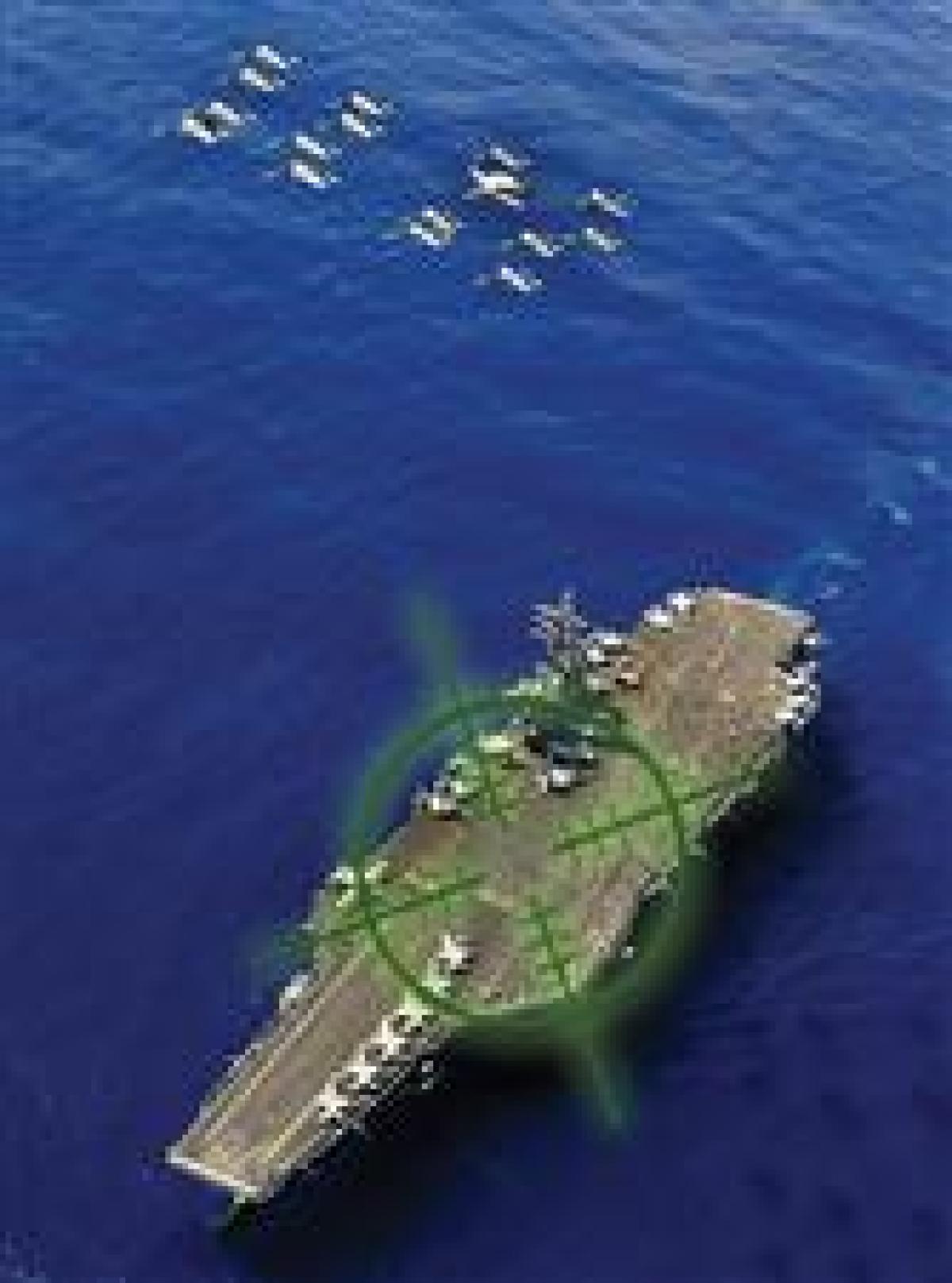
The recently renewed debate over aircraft carrier requirements has focused mainly on the factors of cost and utility. These issues notwithstanding, analysts often overlook or understate the carriers' inherent vulnerabilities. Regardless of the number of carriers national leadership decides to maintain, because they remain the U.S. Navy's preeminent capital ship and a symbol of American global power and prestige, they are a potential key target for both unconventional and conventional adversaries. Carrier proponents, however, universally seem to accept on faith alone the premise that a nuclear-powered aircraft carrier (CVN) is essentially invulnerable.
Yet an intelligent adversary could potentially exploit carrier weaknesses. The sudden, unexpected loss of a CVN, especially by unanticipated asymmetric means, would shock both the military establishment and the American psyche-perhaps being a military equivalent to the Twin Towers' collapse on 9/11. The truth is, a deployed aircraft carrier is more vulnerable to mission kill than is commonly believed, and the Department of Defense should consider efforts to prevent or mitigate such an exigency.
The carrier debate is alive and well. The current effort surrounding the 2010 Quadrennial Defense Review (QDR)and the near-term decommissioning of the nearly 50-year-old USS Enterprise (CVN-65) are raising the volume of the argument, specifically on the number of carrier strike groups (CSGs) needed to meet national and combatant commander demands.
Recurring congressional statutes also dictate minimum carrier fleet size, often despite differing advice from Navy secretaries and military leaders.1 The carrier's value in the post-9/11 era?amidst a global security paradigm defined by the often ambiguous characteristics of irregular, asymmetric, or hybrid warfare-remains an unanswered question. While combat-proven in conventional conflicts and for certain aspects of irregular warfare, future roles and structure of the carrier force remain murky.
Assessments of aircraft carrier vulnerability are not new. The Soviets debated building a significant carrier fleet in the 1960s but determined that large carriers had no place in the nuclear age, partly because of their vulnerability to missiles with nuclear warheads.2 While later choosing to build larger carriers, Moscow always retained the view that carriers remained vulnerable. While the American carrier debate has continued since 1945, it has focused largely on missions, cost, and force structure-not vulnerability.
Presumed Impregnable
The U.S. view of carrier invulnerability is a perilous assumption. If 9/11 taught Washington anything, it clearly demonstrated that fortress America was vulnerable in ways its citizens and defenders never imagined. Terrorists selected targets with maximum psychological impact, employing a relatively sophisticated asymmetric method, seemingly incorporating many of the basic principles of war and operational art: simplicity, synergy, simultaneity and depth, surprise, tempo and timing, security, etc.
The basic operational plan also reflected an awareness of the efficacy of the classic indirect approach-a key aspect of asymmetric warfare. They also exploited a basic vulnerability of open, democratic political systems-a benign operating environment. If a handful of Saudis could plan and carry out effective attacks halfway around the world in a foreign land, why then could other adversaries not accomplish the same in local waters familiar to them?
The typical carrier capabilities that lead to presumptions of impregnability include: speed, armor, compartmentalization, size, defenses (air wing, own-ship, escorts, etc.), blue-water sanctuary (range from shore and from adversary/targets), and technological superiority of U.S. weapon systems. Not often discussed, though, is how a smart enemy might exploit technology or subterfuge to obviate some traditional carrier strengths. Some potential examples include:
- Mass media, satellite communication, and the Internet can provide location and disposition of U.S. carriers when they are near shipping lanes or coastal waters; carrier presence is obvious well before the silhouette appears on the horizon.
- Carriers not supporting a conflict requiring continuous air wing operations will not be operating at higher speeds, especially at night.
- Fast, low profile, open-ocean craft are widely available.
- Armored hangar bay doors are useless when open, typical to lower conditions of readiness.
- Carrier crew size and diversity would likely allow unfettered access to clandestine infiltrators of almost any ethnicity.
- While nuclear power provides virtually unlimited steaming, carriers remain dependent on forward staging areas and supply ships for food, aviation fuel, and stores.
- The insatiable appetite for information afloat is satisfied by way of precious, uninterrupted bandwidth flowing through multiple nodes with varying vulnerabilities.
Next-Generation Weapons Are Here Now
Emerging technologies and new classes of advanced conventional weapons are also making the carriers' ostensible invulnerability more suspect. Most experts see recent advances in foreign antiship cruise missiles (ASCM), offensive information operations capabilities, stealthy diesel and nuclear-powered submarines, deep water rising mines, and antiship ballistic missiles (ASBM) as direct threats to carrier strike groups proximate to the littorals (i.e., when supporting air operations inland). While contemporary conflicts demonstrate no such apparent threats to carriers, they also involve state adversaries without advanced conventional naval weapons.
Hezbollah's effective use of a C802 ASCM against an Israeli warship in 2006, however, illustrates that state order of battle calculations alone cannot provide a total picture of enemy capabilities. Although most Navy leaders avow carrier invulnerability, then-Pacific Fleet Commander Admiral Timothy Keating admitted that the ability to defend against such advanced threats is uncertain.3 While it is beyond the scope of this article to cite specifics, a quick scan of any recent DOD global threat assessment reveals a plethora of emerging weapon systems of concern.4
A corollary to the expanding advanced conventional weapons threat could change the fundamental calculus of the carrier's value. Simply put, increasing adversary offensive threats to carriers require concomitant carrier and strike group defenses to mitigate them. For instance, if the security environment changes such that carriers are threatened with new, better weapons, but in much the same way they were during the Cold War, the brunt of the carrier air wing will again be needed for strike group defense.
The resultant reduction in offensive carrier strike capability-not to mention the significant shift in aircraft/weapons mix and predeployment air wing and ship defensive training-may diminish the carriers' primary role of power projection. Similarly, increased defensive tasking to strike group escorts would limit their support for the myriad regional non-combat missions espoused in the current maritime strategy. Indeed, the reliable provision of air power from an unchallenged carrier witnessed during Operations Enduring Freedom and Iraqi Freedom may well not be the future norm.
Asymmetric Challenges Loom
Conventional threats notwithstanding, carriers are also vulnerable to unconventional or asymmetric threats.5 These potentially include terrorism, sabotage, infiltration, denial and subterfuge (information operations [IO], including cyber and psychological operations), interdiction, and homeport or logistics hub attacks, among others. While many admirals discount such threats outright, again, one need only recall the shock and confusion following the 9/11 attacks.
One reason these threats make military leaders uncomfortable is that they are vague and indiscriminate. Another is that few weapons in the Carrier Strike Group arsenal can directly address them. Indeed, the strike group's inherent capabilities are usually irrelevant against asymmetric threats. Finally, since an unconventional adversary may seek any of these means-and perhaps yet unknown methods-to achieve a mission kill (i.e., not necessarily a catastrophic kill), leaders often swear off as impractical the vouchsafing of every potential carrier vulnerability.
Just as operational art demands a rigorous assessment of adversary center of gravity and critical vulnerabilities, one cannot assume away the enemy's ability to do the same. The 2006 Israeli experience in Lebanon is a recent example of a hybrid conflict, wherein an unconventional enemy knew its opponent well, exploited technology to defeat its armor, directed a sophisticated IO campaign to manage perceptions, and threatened the homeland with incessant rocket and missile barrages.
Gone are the days when the most serious unconventional threats were ignorant, lightly armed fanatics conducting improvised attacks on hardened targets. As such, it is a relatively simple task with readily available information to evaluate the carrier as a system, with critical elements of varying dependency, many of which could degrade mission capability if assailed. Admittedly, adversaries require global reach and significant capability to threaten some elements over the longer-term, but a creative opponent could still seriously limit a carrier's effectiveness, at least temporarily.
Any neophyte can generate a basic list of forward-deployed military unit vulnerability: communications, logistics/lines of communication, crew readiness/morale, mobility, etc. Because the CSG cannot protect everything, the aggressor has the advantage in target selection and surprise.
Pondering the Unthinkable
Carrier proponents typically fail to mention such vulnerabilities. Instead they promote the carriers' inherent ability to operate unfettered off an enemy coast-a virtual fortress at sea. In fairness to the carrier admirals, when threat assessments on the future operating environment present only shadowy non-state actors with undefined or unpredictable capabilities, it is easy to see how some would prefer to focus on the black and white conventional threats. Listing a few hypothetical examples might help demonstrate potential asymmetric carrier threats:
- A carrier operating with only a single escort on an OEF no-fly day, far separated from other strike group warships, is approached by a small team of highly trained, well-armed saboteurs in a low-profile, fast boat at night in international waters. They gain access via a lowered elevator when the ship is in low readiness conditions for a quick surprise attack with satchel charges in the hangar and flight decks to destroy most carrier air wing aircraft before the ship musters a response.
- An adversary state about to seize several small islands in the Persian Gulf directs a small team of special forces to commandeer a large container ship, which veers into the path of a CVN exiting the southern Suez Canal in a restricted waterway. The resultant collision and carrier grounding causes enough damage to limit the carrier to ten knots, preventing most fixed-wing flight operations indefinitely.
- An extremist group targeted by carrier air wing operations identifies the less protected fleet auxiliaries providing carrier strike group logistics in a forward theater and targets them simultaneously with waterborne improvised explosive devices. Critical fuel, food, and stores shortages severely limit air wing operations for a period of weeks.
We Must Not Assume Away Threats
Instilling paranoia is not the intent of these examples; it is only to present the art of the possible. So what can naval leaders do to lessen the likelihood of asymmetric attacks focused on carrier mission kills? First, they must admit that such attacks are possible. Then, undertake a comprehensive assessment of carrier vulnerabilities, with most likely and most dangerous scenarios addressed first for prevention and mitigation plans. Next, naval war game and doctrine developers should make a commitment to present warfighters and defense leaders at war games and red team exercises with situations where conventional, unconventional/asymmetric, and/or hybrid threats marginalize or threaten CSGs.
This will force leaders to challenge traditional assumptions of carrier invulnerability. Finally, leaders and strategists should evaluate military plans and force capabilities in light of the fact that asymmetric attacks may come from either conventional or nontraditional adversaries.
Presuming carrier invulnerability is dangerous. It promotes complacency, prevents a healthy degree of critical thinking, and limits America's ability to prevent and respond to a completely new class of threats. As a CATO Institute study amidst the post-Desert Storm carrier debate related, "Carriers and their battle groups are awesome instruments of war, but they are not juggernauts, as their supporters claim. . . ."6
Pre-9/11 American society provided opportunity enough for a band of radical Muslim brothers to shut down the United States temporarily. Why then could peaceful international waters or territorial seas not provide a similarly benign operating environment today? As defense leaders prepare to make hard QDR decisions, it is high time to renew the carrier vulnerability debate. As former President George W. Bush was wont to state, "Bring it on."
1. The 2005 QDR endorsed an 11-carrier force, which has since been supported by Congress (current plan for 12 in 2019), though the force will drop to 10 upon the CVN-65 decommissioning in 2012.
2. Charles C. Petersen, "Aircraft Carriers in, Soviet Naval Theory from 1960 to the Falklands War," Center for Naval Analyses, Professional Paper 405, January 1984, p. 3.
3. David W. Wise, "Carrier culture shock: The Navy's maritime strategy does not go far enough in reshaping the fleet," Armed Forces Journal, June 2009, http://www.armedforcesjournal.com/2009/06/4034155.
4. See Department of Defense, Office of the Secretary of Defense, "Annual Report to Congress: Military Power of the People's Republic of China, 2009," especially chapters 4 and 5.
5. Asymmetric attack/warfare is characterized by several properties: difficult to detect/recognize, dissimilar in type, disproportional in size and effect, avoids strengths and targets weaknesses, and has significant shock value.
6. David Isenberg, "The Illusion of Power: Aircraft Carriers and U.S. Military Strategy," CATO Institute, Policy Analysis No. 134, http://www.cato.org/pubs/pas/pa134.html.