



The Navy of the future is already here. It only took one recent visit to a ship to drive the point home. As I walked along the pier, a second-class petty officer was busy handling lines. Drawing on my earlier experiences in the Navy, I quickly made the assumption this sailor was serving as a boatswain's mate in deck division. Later, as the ship was under way and the command master chief and I toured the ship, I encountered the same sailor on the bridge. Again, my assumption was that she was the boatswain"s mate of the watch. As I peered over the sailor's shoulder to examine the gauges and screens she was monitoring, I didn't recognize a single one as belonging on the bridge.
Finally, I just had to ask, "Exactly what watch are you standing?"
She looked up and replied, "Engineering officer of the watch."
Now, I was really puzzled, so I followed up, "If you're on the bridge, standing this watch, who is in engineering?" I asked.
"Nobody," was her answer.
She then proceeded to describe the remote-control mechanisms, remote-sensing equipment, and remote damage-control capability at her disposal. At this point I thought she must be from an engineering rate-a machinist's mate, engineman, or maybe a gas turbine tech. In continuing the conversation, I was astounded to discover that she was an electronics technician-standing engineering officer of the watch!
This sailor's primary duties were to maintain and repair the computers and the communications and navigation equipment on board this vessel. But she also worked in the galley once she was relieved of watch and frequently assisted in a number of other duties around the ship at sea and in port. The job description didn't matter.
The Industrial Age at Dusk
Our Navy at present is at the dusk of the industrial age, a time in which we applied the idea of the factory assembly line to our service at large, using linear thinking and breaking problems down to smaller, manageable parts to reach solutions with bureaucratic management techniques. With the speed of information outpacing industrial-age methods to meet the requirements of the present, much less the anticipated challenges of the future, our Navy is seeking ways to capitalize on the exciting possibilities technology can offer.
A host of inventors dabbled in steam propulsion as early as the late 18th century. But it took the U.S. Navy until the late 1800s to abandon sails completely. We hung onto the idea of sails, even as ships tentatively made small steps with hybrid craft in the mid-1800s. Finally, facing the prospect of being surpassed in naval power by European nations such as Britain, the Navy authorized four steel hulls in 1883, driven entirely by steam power. The adoption of this new technology for our ships required basic changes in personnel, as well.
The new technology needed to take the fight to our nation's enemies today likewise calls for new ways of managing and leading our enlisted sailors. Because we now recognize the value of making best use of developments in technology, using a spiral development approach that offers previously unimagined benefits for our joint warfighting capability, we understand, just as the Navy did in the late 19th century, that we need changes in the way we manage and support our personnel. We need to provide an environment that prizes innovation and creativity, one in which we attract and keep the highest quality men and women our nation has to offer.
As I picture my Commodore 64 computer of 20 years ago in some museum, I envision our Navy of even 20 years from now to be as unrecognizable to us as was the Navy of a century ago. Information technology presents new opportunities to rid ourselves of the burdensome duties and jobs that consume our sailors' everyday lives.
Crossroads in History
Just as we made the transition from sail to steam, our Navy today stands at a crossroads in history. One of my strategies is to lead the change in our culture to take advantage of today's technology. At the same time, our challenge is also to ensure our sailors are equipped, motivated, and supported to follow our example.
Admiral Harry Ulrich, commander, Allied Joint Force Command Naples and commander, U.S. Naval Forces Europe, recently said he believed our Navy is preparing to move from missions focused solely on destroying other navies to initiatives that help build navies of friendly nations and our newest allies. Our Navy will be equally adept at the fight to ensure free access to sea lanes as we will be in our humanitarian missions. Indeed, as Chief of Naval Operations Admiral Mike Mullen has surmised, America's positive influence around the world may be felt less by our awesome firepower and more by extending our helping hand.
To meet the Navy's mission in the Global War on Terrorism today, as well as the challenges of tomorrow, our nation demands hybrid, adaptable enlisted sailors, capable of anticipating and reacting. We continue initiatives to motivate those who sit back and wait to be trained. We need those sailors to embrace technology, to pursue the educational process, and to realize their potential for the benefit of the organization.
One Navy plan to meet threats of the Global War on Terrorism and similar asymmetrical threats calls for a shift of thousands of sailors from blue-water to green- and brown-water operations. Increasing the riverine capability to support the joint mission may include interdiction of arms or terrorist smugglers, barricade operations to stop flow to a certain area, training other countries' law enforcement personnel, and visual and electronic surveillance of particular enemy activities.
Our Navy will allow nearly unlimited freedom for innovation, creative thinking, new manners of communication, discoveries of new methods for accomplishing tasks, and innovative industries. It will be fertile ground for human accomplishment. But we must continue to lead the way.
Lifelong Learners
To paraphrase self-educated philosopher Eric Hoffer, in times of drastic change it is the lifelong learners who inherit the future, while the trained usually find themselves equipped to live in a world that will no longer exist.
We have the opportunity to bring the lessons we have learned from the Fleet, communicate in virtual classrooms using new technologies to challenge our long-held and trusted assumptions, hone our critical thinking skills in a constant search for answers, and combine that work in a culture of lifelong learning that draws from the best practices of academia and industry. The Navy cannot afford to limit the potential resources from which we can build the educated, creative force we need. Our centers of learning, which no longer are limited to the brick-and-mortar schools of the present, are better preparing sailors for the future. For example, through technology investment, sailors on board USS Cape St. George (CG-71) are using video teleconferencing technology to take courses on station in the Central Command area of operations.
We are expanding mid-career graduate-level opportunities, creating a culture in which senior enlisted graduates of these programs are not stigmatized for temporarily leaving the Fleet to pursue an education. Instead, they are encouraged to capitalize on that academic experience once they return to an operational unit. In that vein, the first four enlisted graduates of the Naval War College in Newport, Rhode Island, have or will receive orders to Joint Task Force Civil Support; Joint Task Force Guantanamo; Commander, Naval Forces Korea; and Forward Operating Base Camp Lemonier, Djibouti.
The Navy's efforts in joint professional military education, through the Enlisted Professional Military Education Program, will continue to expand advanced education opportunities for our sailors. The strategy in the near term fulfills the need for career-long educational opportunities relevant to the Navy's mission. It allows for the professional and personal growth and development of the total force, equipping our senior enlisted sailors with the right knowledge and skills at the right time. The strategy to incorporate educational programs into a coordinated plan will prepare all our enlisted sailors to operate in joint environments.
By the fiscal year 2011 Selection Board, the Navy will require senior chief petty officer candidates to have an associate's degree. This move sent a strong signal that our service is committed to a culture of lifelong learning. In much the same way we have revisited physical fitness requirements, the Navy wants to provide a powerful incentive to motivate sailors to take the steps now that lead to a degree.
We expect our sailors to focus learning efforts on those competencies that best take advantage of human capability and potential with the high-tech advancements that will become part of our joint warfighting effort. We expect our sailors to concentrate on military and higher education and on those degrees that are rating- and mission-relevant, those that develop critical thinking skills that have a direct impact on accomplishing the mission.
Open Opportunities
In manning the littoral combat ship (LCS) our Navy is moving away from specific ratings with clear job descriptions from junior to senior and a formalized training and promotion pipeline within. Instead, it is moving toward an environment open with opportunity for sailors in a wide range of assignments. While sailors may initially learn skills in a specific field, the culture of lifelong learning offers exciting opportunities to apply talents and skills in other joint warfighting fields.
One of those tremendous opportunities is the announcement of the first Command Senior Chief Selection Board. The Navy is building on the success of the current pilot program on three mine countermeasures (MCM) ships. This board will select additional command senior chiefs for MCMs, as well as for service on board the Gold Crew of the second littoral combat ship to be commissioned. Initially, a limited number of opportunities will be available for command senior chiefs because of the small number of platforms in the near term. Although fewer than a dozen will be selected by this board, future boards will choose command senior chiefs for MCMs and subsequent LCS platforms, along with potential expansion into other operational commands where this level of leadership is deemed necessary.
This move provides an opportunity for the hardest-charging sailors to get into senior enlisted leadership at an earlier point in their careers. Part of the intent of the command senior chief program is to give those senior chiefs a clearly defined path into a command enlisted position. This also represents an investment of the Navy in the leadership our sailors deserve and is an important part of the Navy's Total Force Strategy.
The days when we confronted a predictable and visible enemy with overwhelming force may very well be over. Our enemy alters its tactics at a moment's notice, striking from the shadows. We must meet that challenge with our creative, innovative and educated enlisted people. They will embody our competitive edge in ensuring a safer world, while capitalizing on new opportunities for themselves.
Leaps in Technology, Higher Standards
Leaps in technology-especially information technology-ensure processing data at speeds that alter the very manner in which information is processed and problems are solved. One example is the transformation of the Navy to a force that can be flexibly deployed to meet the specific threats, putting to best use advancements in wide-band communications technology to distribute battlefield information in real time.
Our sailors are capable of performing a vast range of tasks, and their ability to do so will be increasingly valued across the organization. Their skills at solving problems through synthesis and non-linear thinking will be crucial. The Navy values those who can accept responsibility, who can adapt swiftly and eagerly to the changes in our organization, and yet be sensitive to the needs of their shipmates. Those who remain specialized in the status quo of their existing rating will likely be left behind. The Navy is seeking self-reliant and complex people with the courage to think independently and challenge the way we've done things in the past.
We will no longer be recruiting bright young men and women for the enlisted ranks to serve in general detail assignments and to do mundane, repetitive tasks. These jobs ultimately will be outsourced or, with the emergence of technology, eliminated altogether. With that in mind, standards for our sailors have kept pace. Initial accessions with at least a high school diploma over the past 30 years have risen from 70% to more than 95%. In the past five years, reflecting the Navy's demand for increased education in its recruiting pool, initial accessions with at least 12 credit hours of college have doubled.
In response to the quality of the enlisted force, our leadership and education methods have moved from traditional, tried-and-true approaches to acceptance of constant experimentation, drawing on a wide range of resources. Our leadership is now a flatter organization, with lines indicating horizontal interaction rather than keeping a hierarchal decision tree. We're taking advantage of the interaction between leaders and followers, a dynamic in which persuasion rather than coercion, from a number of levels and from different directions, helps promote real changes that enhance our ability to conduct our mission.
The Navy is adapting a knowledge-based organizational flexibility, one that defines the way we meet the mission, based on changes and threats in the world. As we focus on lifelong education to best capitalize on information technology, we are finding that an additional salutary result is building greater, more diverse, and stronger communities. In fact, using group dynamics, facilitated by information technology such as posting boards or chat rooms, the Navy is finding that such real-time sharing of knowledge is also enhancing creativity and learning.
Adopting technology as a tool for greater productivity and as a means to explore the world requires more than training to perform predictable and routine duties. Rather, those who seek and are encouraged to pursue education will be able to confront the unpredictable, anticipate the impossible, and plan for the unimaginable changes technology will bring to society.
Not on My Watch!
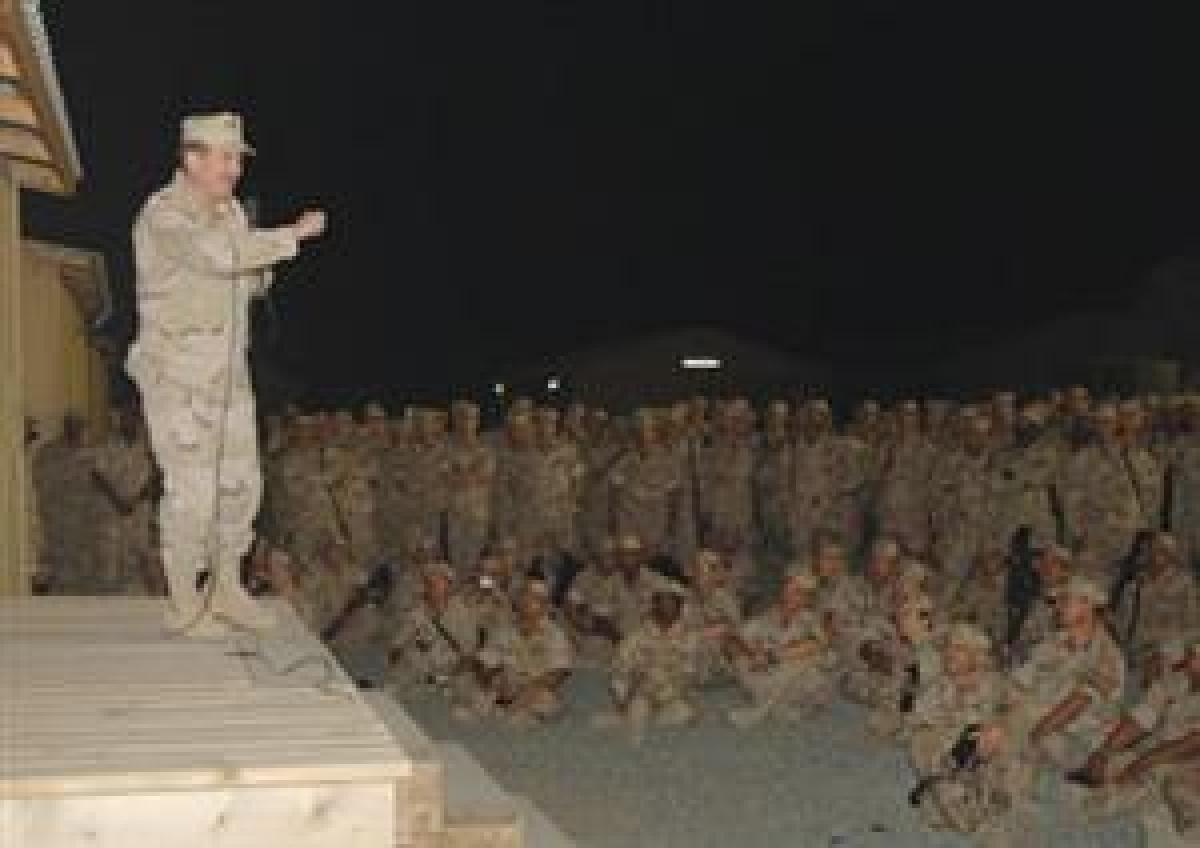
This year, I had the good fortune to visit with thousands of our sailors currently serving on the front lines of the Global War on Terrorism in Iraq. As I looked into the determined eyes of those who are performing this difficult mission, under impossible conditions, it was not lost on me the type of people on whom our Navy relies. Our families, friends, and fellow citizens who call America home should be grateful those young men and women raised their right hand and swore to stand the ground between them and those who would do us harm. To each one of us in this country, they say, Not on my watch!
We owe the sailors who deploy nothing less than our best effort to give them the guidance and the equipment they need to succeed. These young men and women need to understand that what they are doing is important and vital to accomplishing the Navy's mission. It doesn't matter what job they're doing-from providing security for detainees in Iraq, or repairing gear on board a cruiser patrolling the Horn of Africa, or supporting those who do-the Navy needs them.
Enlisted sailors join the Navy to find opportunities for training, leadership, and possibly a new direction in life. This institution would be ill equipped to build the force of the future if we did not find a way to use all the capabilities of those people. They respond to a challenge with a sense of contribution and accomplishment. Which one of us doesn't relish the elation and self-satisfaction that comes with completing a difficult challenge or mission? By allowing all enlisted sailors know how their individual jobs contribute to the success of the mission, we not only help them understand how each job is important, but that someone in leadership cares about them and their continued growth.
The value the Navy places today in those lifelong learners, within our joint operating environment, capitalizes on the creativity and motivation of the best people America has to offer. And they are crucial to the long-term security and health of our country. We are depending on our best thinkers and learners to step up and serve in the defense of our nation, to serve with the finest and most capable fighting force the world has ever known.
Master Chief Petty Officer of the Navy Scott assumed his current position in April 2002. In this post, he is senior enlisted advisor to the Chief of Naval Operations and the Chief of Naval Personnel.