



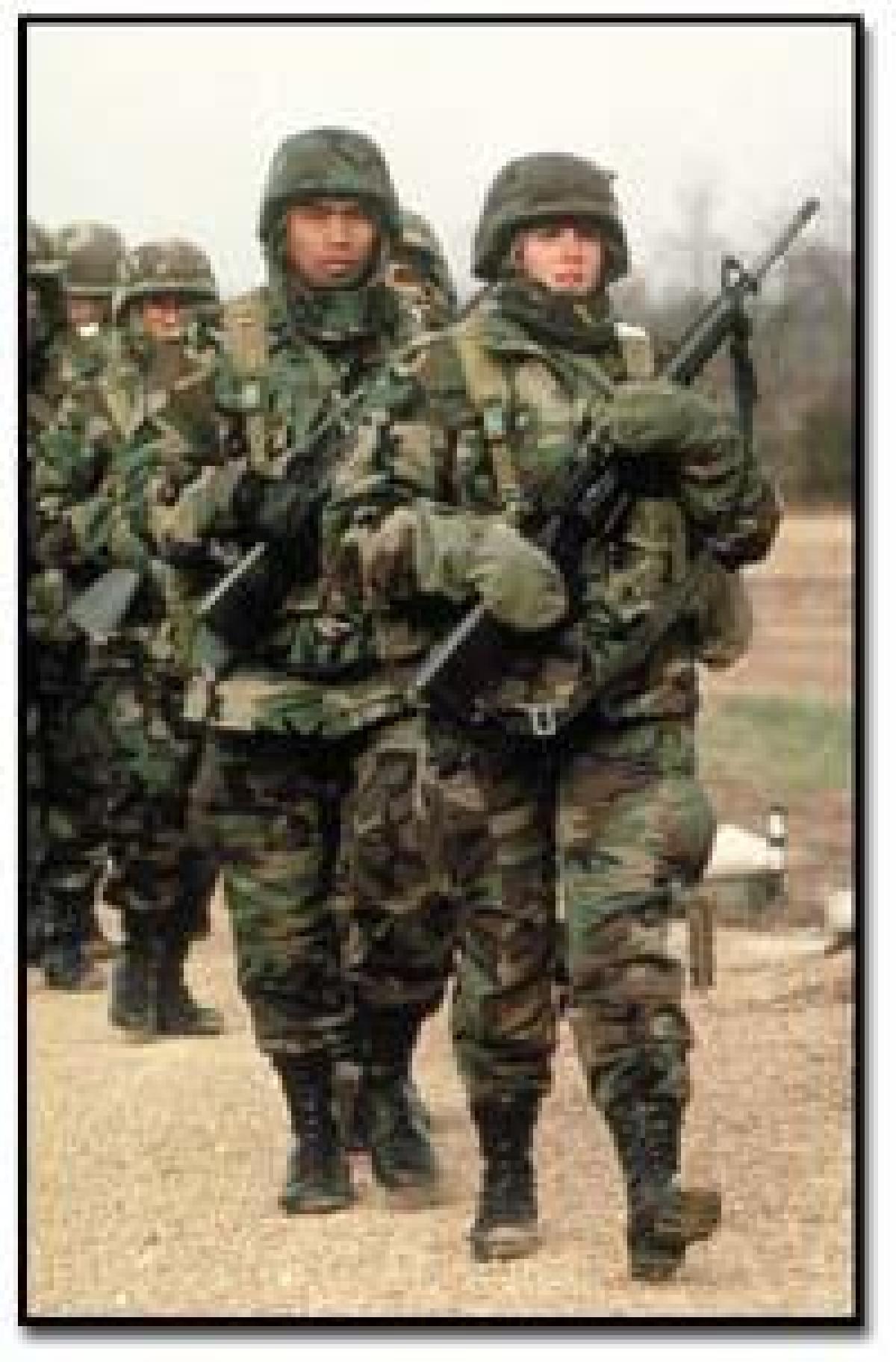
There appears to be a growing gap in understanding between civilian society and the U.S. military. If there is such a gap, does it mandate a reduced role for women?
There is considerable discussion about a "gap" between civilian society and the military. There is certainly a gap in understanding between civilians and the American military, but it is more natural and less frightening than some commentators claim.1 There always has been such a gap, even in wartime, and it always has grown wider in periods of peace.2 It exists because the military has a unique role, which is often misunderstood, sometimes feared, and regularly questioned by civilians. It also exists because some in the military isolate themselves from the society they are sworn to protect. The gap creates problems, but those problems do not justify either a diminution of civilian control or a reduced role for women, as some have maintained.
American history—and the Constitution itself—shows that this country never has been comfortable with a truly professional military, as opposed to citizen soldiers who serve only in time of need.3 The gap exists today because today's military, volunteers all, have chosen a vocation with a unique mission: to prepare for and fight the nation's wars. This mission may result in a lack of civilian understanding of and interest in the military, and also in disdain by some of the military for what are said to be the looser, more "modern" values of civilian society. For instance, commentator John Hillen, a former U.S. Army officer, describes the values of today's America as "narcissistic, morally relativist, self-indulgent, hedonistic, consumerist, individualistic, victim-centered, nihilistic, and soft."4
It is often said that if the gap becomes too wide, Congressmen without experience in military affairs may fail to support adequate military budgets or alternatively may fail to exert the oversight required by the Constitution. Or the military, because of disrespect for the Executive Branch—and in particular the Commander-in-Chief—may fail to obey lawful orders. Long before that happens, the military establishment's loyalty to civilian leadership may begin to disappear, and uniformed leadership may openly question national policy when they disagree with it. Or there could be an increasing use of the armed forces for domestic purposes until the military becomes convinced that the preservation of domestic order and American values as they define them is part of its mission. Militarism would result.5
The issues are complex, but it is important not to exaggerate the problems. For example, there is no single military culture. All four branches have different cultures, with sub-cultures defining parts of each service, and the nature and extent of any gap differs with each sub-culture, as well as with individual service members.
If there is a significant gap between civilians and the military, it is certainly not shown by any lack of civilian support for the military. Instead, the gap is chiefly evidenced by the disdain that some—but far from most—of our military apparently feel for American society and for the civilians who are responsible for oversight. It is clear from his book and speeches that Tom Ricks admires the Marine Corps, and finds its sense of purpose and pride a useful example for the other military services.6 Yet he also fears the strength of a culture which not only encourages Marines to feel superior to civilians but also has a few Marines ignoring the law as they see fit.7
Civilian Control
Can civilian control work properly when there are fewer connections between society and its peacetime military establishment? This is a serious problem, it is reasoned, because the professional military remains large and expensive despite extensive downsizing, and because its purpose of fighting and winning wars appears to have been diluted by its civilian masters. The United States has no "peer competitor," and the growing use of the military for peacekeeping missions unfamiliar to Americans who grew up in the shadow of the communist threat creates uneasiness. These missions often are viewed with displeasure by military leadership.
Further, because the military is available, and less visibly expensive than its alternatives, the principle behind posse comitatus8 is ignored and the military is more frequently used domestically as a convenient police force.9
Perhaps most important, the military leaders tend to be better-educated and more skilled in Washington bureaucratic politics than their civilian counterparts. Civilian control is given lip service, but those in uniform make the decisions, manage the budget, and control essential information. At the same time, civilian leadership is criticized as ignorant in defense matters and uninterested in the nuts and bolts of what makes a professional military.
Military personnnel enjoy the highest respect of any professional group in our society, which has resulted in a new timidity in challenging the military establishment. A tendency to use military issues for political gain is compounded by partisan rhetoric that blames problems within the military establishment on civilian leadership.
The links between the military and Congress are complex, and military leaders are increasingly skilled at using Congress to obtain funds they cannot get from the Administration. Whether the issue is increased budgets, detriments to readiness, or even the impeachment of a President, some in the military appear willing to play partisan politics.10 There may be short-term gains for a political party having uniformed officers on its side, but in the long run the respect for the military and its tradition of selfless service is damaged.
Perhaps the most frequently cited example of the failure of civilian control is the dismal history of "don't ask, don't tell." President Clinton's inability to carry out his policy of allowing homosexuals to serve openly in the armed forces certainly suggests a failure of civilian control by the Executive Branch, but those on the Hill who are traditional supporters of the military defended the vocal and predominant military view that openly homosexual personnel would destroy unit cohesion.
Women and the Gap
The second major issue often phrased in terms of a gap is whether the "social experiment" of bringing more women into the armed forces—and opening jobs for them previously reserved for men—has weakened or drastically changed the military ethos.
On its face, this is less clearly connected to civil-military relations. After all, what suggests that the presence of women in the military is a misguided notion of current civilian leadership when women have been serving in significant numbers for more than 25 years? Those who use women to prove that the gap exists primarily focus on this Administration's approval of opening some combat and near-combat positions to women.11
Those worried about women in the military want to return to a much more limited role for women in the military, and claim that this is both appropriate and achievable. But without a draft, how could the military operate without women personnel?12 The issue of women in combat, and particularly ground combat, is often described as the key issue, although women are not in the combat arms, and do not fill combat billets except as aviators and on board ships.13
Gender has thus been made a serious issue in civil-military relations. In an effort to link the issues of civilian control and women, it is argued that civilian control is endangered not simply by civilian incompetence, but also by the professional military's disdain for civilian society and its values—particularly if society, through its elected representatives, attempts to impose those values on the military. Such interference is described as using the military as a "social laboratory" or "social experiment"14 by forcing acceptance of homosexuals and by opening additional military positions to women. Oliver North uses rhetoric that echoes many other critics when he writes that "the 1.4 million young men and women of our armed forces have been treated like lab rats in a radical social experiment."15
This line of argument is profoundly inconsistent with our national history. It ignores the reality that civilian oversight has always included particular concern for personnel matters. For example, proposed changes to the Uniform Code of Military Justice are extensively reviewed by civilian lawyers in the Department of Defense and Congress and must be approved by Congress or the President.16 Similarly, civilian officials in the military departments and the Office of the Secretary of Defense review promotion lists to ensure fairness and compliance with congressional direction. Those same civilian appointees investigate cases concerning individual soldiers in which it is suspected that the system has not worked as Congress has directed. Title 10 of the U.S. Code contains hundreds of directives about the governance of military personnel—many of which were enacted against the wishes of the military.
Civilians in the Executive Branch and Congress always have established the rules and policies governing military personnel. In a democracy, the rigid hierarchic system necessary for a professional military is accepted, but only with safeguards to protect American soldiers which are put in place and enforced by civilians. Because civilians make the decisions concerning promotion policies, personnel policies, and the budget, Americans can be reasonably confident that their sons and daughters will be protected against arbitrary and capricious punishments, or other inappropriate or unfair actions by their commanders or the "system."
Women and the Military Ethos
How does the presence of women in the armed forces relate to civil-military relations? The argument is that without "liberal" and "feminist" pressure from the Executive Branch, women would not be eligible to serve in combat or near-combat positions and there would not be so many women in the services. Their presence in such numbers is assumed to degrade the quality of the force and distract the warrior from his duty—even though the only facts offered for this proposition are that women have inferior upper body strength and get pregnant. It is argued that women do not belong in their current military roles because their very presence in units with men is harmful to the military ethos or the warrior ethic.17
This issue is created by those who admire the "warrior spirit," and define it in a way that can belong only to a male soldier. The services of women during past conflicts and the roles they play in the modern military are ignored or forgotten. It is assumed that without interference from civilian society—which has given equal rights to women—the military would be stronger, and more ready to fight.
The argument is somewhat confusing, as is the use of "culture," "ethos," and "warrior spirit" almost interchangeably. These terms are purposely broad and inclusive, intended to discriminate between civilian and soldier—not necessarily between soldiers. Although no clear definition of "warrior spirit" exists (except that it excludes women), the "military ethos" is a broader term that does not, in itself, exclude women. The ability to fight and the readiness to risk life if necessary are basic to the culture of the military services.
Women in the military have no reason to disagree with such a description of military ethos or culture. They joined the military, after all, for the same reasons the men did. Women soldiers generally resent any implication that they do not embody soldierly virtues, and that they are not ready to do what their country asks of them.18 But the argument goes further and defines unit cohesion to exclude female soldiers. It is hypothesized that women in Army or Marine ground combat units would destroy unit cohesion. In an extended form, the argument applies to naval warships, now open to women, and to combat aviators, since a small number of women are combat aviators in all services.
There is no proof for this thesis. Unit cohesion is indeed essential for any military unit to operate effectively, but no one has yet defined what is necessary for combat cohesion. The few studies that have been conducted suggest that the factors have differed in every war, but that "solidarity and social intimacy" are most important.19 At a minimum, however, definitions of unit cohesion which ignore the importance of leadership and good morale are inaccurate and unrealistic. Definitions that focus on relations within the group assume that leadership is almost irrelevant and that the group will remain together, which is not consistent with Army rotation systems.
Gender Integrated Training
As some Members of Congress became more strident about the failures of the Clinton Administration, real or imagined, they also began seriously to question the role and number of women in the military. Those who argued that gender destroys unit effectiveness began to point to gender-integrated basic training as an example of what can go wrong when the sexes are thrown together in a stressful environment.
Incidents of sexual harassment and misbehavior were used as evidence that women did not belong in the military. Despite the fact that the Army concluded after the Aberdeen incident that a lack of hands-on leadership and a zero-defects mentality were to blame for the problems, the gender-integrated basic training used by three of the four services became the primary issue.
The three services that have integrated basic training are confident that they can continue to regulate improper behavior, whether in basic training or in units. They are also confident that the weaknesses that affected the training environment can be corrected and do not stem from gender-integrated basic training.20
It was argued that gender-integrated basic training was part of a "social experiment" forced on the military, whose leaders presumably remain silent because of their "political masters."21 This is simply not true. General Gordon Sullivan, former Chief of Staff of the Army, wrote a strong letter to the House National Security Committee reminding its members that he authorized gender-integrated basic training for the Army. He later testified to the same effect before the Congressional Commission. Although a majority of the Congressional Commission agreed that gender-integrated training was working, the dispute persists.22
Unfortunately, if gender-integrated basic training is ended, the next logical move would be to take women out of the warfighting divisions in the Army. If military leadership cannot enforce standards of behavior for trainees, it will be argued, how can it regulate the sexual behavior of soldiers and sailors, who have much less supervision? They would no longer fill the combat support and combat service support roles that they perform today, which make it inevitable they will go to war. Women would be removed from combat ships for the same reasons.
If some women are not doing their jobs, and are not meeting physical standards, then they should be retrained or removed from those jobs. The same is true of men. The military should do what it did with the integration of African-Americans, and work actively to ensure that all soldiers, regardless of gender, are properly trained, motivated, and led. The current obsession with technology, a zero defects mentality that belittles hands-on leadership, and the failure to emphasize and properly fund training are all genuinely dangerous to the military ethos. The presence of women is not.
Basic standards of fairness forbid the removal of women, and fairness is essential to the honor that infuses the military ethos. Removing women would also show a basic weakness in military culture by demonstrating that careful planning, good training, and strong leadership could not resolve gender issues, unlike all other social issues.
Gender is likely to remain part of discussions about the "gap" until the military establishment recognizes that it is responsible for ensuring that every soldier can do his or her job, without interference or harassment because of gender. It is instructive that although there have been women at the Naval Academy for 20 years, the matter is still regarded as open to debate when James Webb and Elaine Donnelley write of the unhappiness of male midshipmen because they have women classmates.23 If the presence of women (unlike any racial or religious group) continues to be debated as if it were an unresolved issue, how can anyone convince those midshipmen that women matter to the Navy?
How long will sociologists continue to ask officers how they would feel if their commander were a woman? No one would ask whether they were willing to be led by a member of any other minority group in the military. The promotion system has been carefully designed to pick the best leaders. The military ethos demands that those leaders be obeyed, whatever their race, gender, or other individual characteristics. If it is a matter of performance, we should ensure that the standards are fair and sensible, and that the best are chosen without regard to race, background, or gender. And then we should get on with addressing the real problems of national defense.
Mrs. Lister is the former Secretary of the Army for Manpower and Reserve Affairs. She has also worked in the Pentagon for the Navy and the Secretary of Defense. She lives in Key West, Florida.
1. For a summary of recent academic literature on civil-military relations see Deborah Avant, "Conflicting Indicators of eCrisis' in American Civil-Military Relations," Armed Forces and Society, Spring 1998, p. 375; Richard H. Kohn, "Out of Control: the Crisis in Civil-Military Relations," The National Interest, Spring 1994, p. 3; Mackubin Thomas Owens, "Civilian Control: A National Crisis?," JFQ, Autumn-Winter 1994-95, p. 80; James Kittfield, "Standing Apart," National Journal, 13 June, 1998. back to article
2. In his classic work, Samuel Huntington showed that it was essential for the military to be different from civilian society. Samuel P. Huntington, The Soldier and the State: the Theory and Politics of Civil-Military Relations (Cambridge, MA: Belknap, 1957). back to article
3. The Constitution provides for extensive oversight of all thing military by both Congress and the Executive Branch. It also details a major role for the militia—citizen soldiers whose first responsibility is to the states. back to article
4. John Hillen, "Must U.S. Military Culture Reform?," Orbis, Winter 1999, p. 53. back to article
5. Colonel Charles J. Dunlap, Jr., USAF, "The Origins of the American Military Coup of 2012," Paramaters, Winter 1992-3, p. 2. back to article
6. Thomas E. Ricks, "Is American Military Professionalism Declining?," United States Naval Institute Proceedings, July 1998, p. 26. back to article
7. Thomas E. Ricks, Making the Corps (New NY: Scribner, 1997), p. 292-3. back to article
8. The Posse Comitatus Act provides that with certain exceptions expressly authorized by the Constitution or by statute, the military services shall not be used for civilian law enforcement functions. 18 USCA Sec. 1385 (1984). See Thomas R. Lujan, "Legal Aspects of Domestic Employment of the Army," Parameters, Autumn 1997, p. 82. back to article
9. The military is now heavily involved in drug interdiction. The growing use of the military as security forces in large events such as the Atlanta Olympics is another example. back to article
10. See Andrew J. Bacevich and Richard H. Kohn, "Great Army of the Republicans," The New Republic, 8 Dec., 1998, p. 22. back to article
11. Mackubin Thomas Owens, "It's Time to Face the Gender Paradox," U.S. Naval Institute Proceedings, July 1998, p. 43; James Webb, "The War on the Military Culture," The Weekly Standard, 20 Jan., 1998, p. 17; Robert L. Maginnis (Family Research Council), Testimony on Military Culture before Sen. Subcomm. On Govt. Management, Restructuring, and D.C., 7 Oct. 1998. back to article
12. There are approximately 200,000 women in the military today: 14% of all U.S. active duty personnel. Theoretically, they could be replaced by a limited draft. Even the current Supreme Court, however, would have difficulty finding that a males-only draft was consistent with the Constitution. It would be necessary to prove that women are unable to perform many of the jobs they are already doing. back to article
13. Most of those who argue violently against women in combat are aware that women are not allowed in the ground combat arms, but also know that women fill positions in combat support and combat services which will put them on the battlefield and expose them to risks similar to those faced by the combat arms. back to article
14. The phrases are often used interchangeably. Both are polemical descriptions of policy changes, and were used when President Truman signed the Executive Order integrating the military. General Marshall, for one, was doubtful that the "social experiment" of integration could work. back to article
15. The Washington Times, 6 September 1999, p. 2. back to article
16. The Code was enacted after World War II to provide a uniform system of military justice to military personnel of all ranks. Charles Moskos, The American Enlisted Man (NY: Russell Sage Foundation), p. 9. back to article
17. See testimony of Mackubin Thomas Owens before the Congressional Commission on Military Training and Gender-related Issues, 17 March 1999, p. 14. He contends that the Clausewitzian friction of war is alleviated in part by the military ethos and that women endanger it. See also Paul Craig Roberts, "Cultural Demolition in the Military," Washington Times, 20 Nov. 1998, p. 20. back to article
18. That the great majority of them do not want to be in combat is beside the point. Studies show that most male soldiers are not eager to go into combat. Both male and female soldiers, however, will obey orders and go into harm's way. back to article
19. See Charles Moskos, The American Enlisted Man (NY:Russell Sage Foundation, 1970), pp. 74, 120, 135, and 156; Col. Charles W. Brown and Charles C. Moskos, Jr., "The American Volunteer Soldier: Will He Fight?" Military Review, Jan.-Feb. 1997, reprinted from June 1976; J. Glenn Gray, The Warriors: Reflections on Men in Battle (University of Nebraska Press, 1998), p. 39. back to article
20. Before the Army military leadership began integrated training, research was done to determine whether such training could meet the Army's training goals for both men and women. The study, while concluding that gender integrated training would be successful, made clear that certain changes should be made to ensure its success. The study's recommendations were not followed, and training continues to suffer from a lack of funding more serious than that faced by the rest of the Army. back to article
21. James Webb makes such accusations with regularity, about many issues affecting the Navy. See, for example, his speech at the Naval Academy, "Military Leadership in a Changing Society," 16 Nov. 1998. See Sam C. Sarkesian, "When Should the Military Speak Up?: A Civil-Military Dilemma," Current, Oct. 1998. back to article
22. See testimony of Anita Blair before the Subcom. On Military Personnel, House National Security Comm., 17 March, 1999, p. A-4. When General Franks began the testing of gender integrated basic training, and later when General Sullivan was briefed on the results of that test and approved expansion of gender-integrated training, there were no political appointees at the senior levels within the Army. back to article
23. Paul L. Roush, "A Tangled Webb," U.S. Naval Institute Proceedings, August 1997, p. 42. The published comments following the article are instructive. back to article